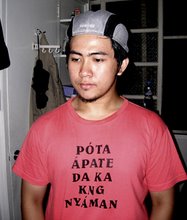
Alben meng manyaman, boy!

Showing posts with label Geography. Show all posts

June 5, 2009

Palawan Subterranean River National Park: A Global Wonder of Nature

By Jason Paul Laxamana
Urban Kamaru
Central Luzon Daily


Last month, my Kamaru production team and I flew to Puerto Princesa City, Palawan to co-produce the music video of the carrier single of an upcoming Cuyonon rock album by a band called Bulyaw Mariguen.

During our stay, our producer Jocelyn Fabello of Matinlo Productions took us to one of country's pride in the realm of ecotourism—the Puerto Princesa Subterranean River National Park (also called St. Paul Underground River National Park), a nominee in the “New Seven Wonders of Nature” competition and one of UNESCO's World Heritage Sites.

Trip to the Park

We woke up early in the morning and rode a van to reach the place. Even though we were staying in Puerto Princesa City, the barangay (Sabang) where the park is located is far from the heart of the city, and the trip can range from one hour to an hour and a half.


It's not all land transportation. Upon arrival to Sabang, we had to take a short banca ride at the Sabang Pier—about ten minutes—to reach the national park, which is on the other side of the beach. The water we had to travel across comes from the South China Sea already.

The trip is short but we were stunned with the beauty of the surrounding shores, forests, and mountains. Plus, the water is not murky compared to the waters of Pampanga Bay; the water is also greenish blue—probably a reflection of both the sky and the lush forests from nearby bodies of land—and best of all, clean.


Upon landing, we enter a safe forest that would lead us to the small port where the City Government of Puerto Princesa. In that short trek inside the forest, we encountered monkeys and monitor lizards (bayawak) freely roaming around.

The monkeys, like the ones in Subic, are infamous for snatching stuff from people, so we were advised to keep an eye on our things and to not leave our possessions unattended. Physically harming the monkeys, along with the lizards and the other animals that may be found in the forest, is unlawful.


The giant monitor lizards, especially for us urban people, were both fascinating and frightening due to their baby dragon-like appearance. Fear not though because they don't attack people.

In fact, according to the locals, they are afraid of people. Their seemingly casual behavior around humans is only because they have been used to their constant presence in the area. But if you try to shock one, it will run away fast like a shooed cat.


Into the Cave

After the short trek, we arrived at the port where tourists can avail of group boat rides—paddled by local employees—through the cave. A tour inside the cave, which can last from thirty to forty minutes, would have cost us money, but since our trip was sponsored by Mayor Joel Reyes of Puerto Princesa, we went in for free.


We enter the mouth of the cave where it's pitch-black all through. A spotlight is held by the passenger in front though, allowing everyone to scan the surroundings which is filled with stalactites, stalagmites, sleeping bats, and swiftlets that fly around the area. At first, we mistook the swiftlets as bats, but the boatman—who serves as tour guide and entertainer as well with his funny side comments and knowledge of greetings in several Philippine and world languages including Kapampangan and Niponggo—informed us that they were birds, swooping down on insects to dine.


The cave, while the lower part is submerged in approximately 30 feet of fresh water (the water at the entrance is somewhat salty though as evidenced by the seashells forming on the walls because the entrance is near the point where the river and sea meet) still had a huge dome space above, where water droplets were falling down mildly at random points.

The water was coming from the rainwater accumulated above the terrain, seeping down through soil and rocks, until it reaches the cave.

“The water dropping from above can be considered Holy Water,” the boatman comments. “But if what drops from above comes from the bats, it's Holy Shit.” We burst in laughter.

Various stone and rock formations inside have names like the Holy Family, LRT, the face of Jesus Christ, Bat Cave, the Pegasus, the T-Rex, and many more. They had been named as such because the formations appeared like them, especially the breath-taking face of Christ.


We couldn't help but wonder how such place was formed. The boatman said that the cave could have been water-free back in the centuries when sea levels were lower. While the documented discovery of the underground river is credited to a Spaniard, the natives of Palawan could have known the area as well, except that there hasn't been any piece of evidence found yet.

After a cozy tour inside, we reached the point where boats are supposed to return. No, it was not the edge of the tunnel yet. In fact, the edge was still far away, and we were even informed that a huge empty lot where a hundred people or so can camp was situated there.

“Gusto niyo bang puntahan?” the boatman asked. “Yes!” we all excitedly replied. “Sige, puntahan niyo, hihintayin ko kayo dito... promise!” he answered. Again, we laughed hard.

The reason they don't take tourists, or anyone for that matter—except if people with enough reason like geographers and scholars have permits from the proper authorities—to the far reaches is because it could be too dangerous and distant from the port, such that if emergency happened, rescue will take time to come.

Ecotourism VS Environmental Protection

One might wonder why there aren't many boats available to rent, causing people to wait long in line before experiencing the cave. Boats could be enlarged to accommodate more people per trip, but why is it not being done?

It's because it's not purely ecotourism for the national park. Concerned with the animals, like the nocturnal bats sleeping inside, they limit the number of people inside the cave to not cause too much noise. “Travel agencies keep on suggesting that we increase the number of boats, but we tell them we don't want to strongly disturb the dwellers inside.”

Puerto Princesa City is lucky to have such natural wonder, and the natural wonder is luck to have an understanding and sincerely passionate group of people looking out for its preservation. Even though the government keeps on promoting the place, it doesn't abuse and over-commercialize the whole idea, unlike what happens in other places.

For more information about the place, visit the official website of the management. www.puerto-undergroundriver.com

Photos care of Diego Marx Dobles, Kamaru Photography

May 4, 2009

East Versus West (Asians and Americans think differently)

By Hana Alberts
Forbes.com


A psychology professor dares to compare how Asians and Americans think.


Richard Nisbett used to be a universalist. Like many cognitive scientists, the University of Michigan professor held that all people--from the Kung tribe that forages in southern Africa to programmers in Silicon Valley--process sensory information the same way. But after visiting Peking University in 1982 and partnering with an Asian researcher, Nisbett found his beliefs challenged.

He embarked on a project to probe the thought processes of East Asians and European Americans. His experiment presented subjects with a virtual aquarium on a computer screen.

"The Americans would say, 'I saw three big fish swimming off to the left. They had pink fins.' They went for the biggest, brightest moving object and focused on that and on its attributes," Nisbett explains. "The Japanese in that study would start by saying, 'Well, I saw what looked like a stream. The water was green. There were rocks and shells on the bottom. There were three big fish swimming off to the left.'"

In other studies Nisbett discovered that East Asians have an easier time remembering objects when they are presented with the same background against which they were first seen. By contrast, context doesn't seem to affect Western recognition of an object.

"I thought there wasn't going to be any difference, and then we kept coming up with these very large differences," says Nisbett, a stately, white-haired man of 67, as we sit in the Upper East Side headquarters of the Russell Sage Foundation. In lieu of his regular salary, he has a grant from Sage to research the nature of intelligence while on sabbatical from Michigan's psychology department, where he has taught since 1971.

Scientists now attach gizmos to people's heads that track eyeball movement; these experiments have confirmed Nisbett's findings, recording that Americans spend more time looking at the featured object in an array while Asians take in the entire scene, darting between background and foreground.

East Asians see things in context, while Westerners focus on the point at hand; the former are dependent, the latter independent; the former are holistic, the latter analytic. There's a social aspect to these differences: Asians are collectivistic, Westerners individualistic.

Even if cognition does differ across cultures, why should we care? For one thing, it might help explain why we're prone to bubbles. In Nisbett's 2003 book The Geography of Thought he describes a study in which students were shown a graph with a line snaking upward across it, representing a trend like world deaths from tuberculosis or the gdp of Brazil. Investigators asked subjects to indicate how they thought the trend would continue. Many Americans sketched a line that continued skyward, while most Chinese forecast a peak and then a decline. A colleague of Nisbett's also showed that while Canadians predict a stock whose value is rising will continue to rise, Chinese think what goes up will come down. An intriguing difference, although one wonders if 1998's pancontinental financial crisis in Asia or the real estate and stock market crash in Tokyo affected students; in the U.S. the Nasdaq crash of 2000--02 was not as memorable. Nisbett doubts the theory but admits "the Confucian idea that the future will resemble the past is deeply ingrained in the Asian mind."

He reasons that cross-cultural differences can also explain societal phenomena. Nisbett defines a nation's preference for lawyers over engineers as a ratio: the number of the former divided by the number of the latter. When he compared America's ratio to Japan's, he found that the U.S. preferred lawyers over engineers 41-to-1. The American system, he says, prizes win-or-lose judgments, while Japan's preference is for middlemen who draft compromises.

In his most recent book, Intelligence and How to Get It: Why Schools and Cultures Count, Nisbett asks why Asian-Americans score higher on the sat than other Americans and why students in Asian nations do so much better on international math and science exams than their U.S. counterparts. The answer is not, Nisbett says, that Asians are smarter. Rather, he writes, "Asian intellectual accomplishment is due more to sweat than to exceptional gray matter." The tests measure proficiency as much as innate skill, and the proficiency comes from cultural forces, such as the Asian sense of obligation to the family. Another factor is that math lessons in Asian schools have a student working out a problem on the board as classmates chime in. That kind of collectivism confirms the commonly held belief that learning by organic induction is more effective than rote memorization.

Why do you find, in a music conservatory, a lot of Asian would-be concert pianists but comparatively few Asian opera-singers-in-training? There's a physical limit to how many hours a day a person can sing, Nisbett says, but not to how many hours one can practice sonatas.

He attributes these differences to history. East Asian agriculture was a communal venture in which tasks like irrigation and crop rotation had citizens acting in concert. In contrast, Western food production led to more lone-operator farmers and herdsmen. Greek democratic philosophy emphasized the individual; the Reformation stressed a personal connection to God; the Industrial Revolution made heroes of entrepreneurs. But in Asia, Confucius said virtue hinged upon appropriate behavior for specific relationships, say, among siblings, neighbors or colleagues.

These tidy generalizations are not without critics. A San Francisco State University professor who edits the Journal of Cross-Cultural Psychology, David Matsumoto, holds that while Nisbett attaches his observations to fascinating raw data, he takes some conclusions too far.

"In cross-cultural work researchers are too quick to come up with some deep, dark, mysterious interpretation of a difference with no data to support it," Matsumoto says. "It's difficult to draw one conclusion [from] a snippet of behavior, and that's what this work tends to do."

Though Nisbett believes our behaviors are shaped by 2,500 years of history, he also thinks they are malleable.

"I got interested in whether you could make people better at reasoning and problem-solving by certain kinds of education, and it turns out you can," he says. If Americans are asked to think about how they are similar to other people they know, they view the aquarium scene more like Asians--and vice versa. "So these things aren't necessarily locked in."

When it comes to cross-cultural business, Nisbett observes, East Asians want to establish relationships, while Westerners tend to keep their business connections at arm's length. Westerners operate by the exact wording of a contract, while East Asians hold that if circumstances change, so should the agreement. Marketers, of course, are aware of cultural differences. For the same phone, Samsung emphasized contrasting messages: In the U.S. the message was "I march to the beat of my own drum," whereas in Korea the ad campaign focused on families staying connected.

But Nisbett noticed shifts within the Asian cohort last year, after he observed a group of Chinese students at a Procter & Gamble ( PG - news - people ) focus group.

"My goodness, they were as lively as any group of American graduate students I've ever had. If I said something they didn't agree with, they let me know. … I would never, ever feel that way with Japanese or Koreans, who are more concerned with harmony," he says. "I think the Chinese will be more successful than the Japanese have been because they have that sense of obligation to family, but they're also going to get this more Western attitude of wanting to succeed as individuals."

Perhaps, Nisbett speculates, the personal drive one sees in Chinese entrepreneurs is a consequence of China's one-child policy. Because two parents and four grandparents dote on an only child, individualism is emphasized more than it used to be. As a result, Chinese youth are moving in a Western direction.

In the last half-century Japan has undergone a huge shift toward democracy, but this hasn't been accompanied by an increase in individualism, Nisbett says: "Japan is evidence that nothing changes. China is evidence that things can change like mad."

Why is Nisbett something of a lone wolf in studying the role of geography in cognition? His answer: "A lot of politically correct academics can't stand to hear about differences. They automatically assume that if you're pointing to difference, you're assuming superiority of your own culture. Well, that's just nonsense."

The upshot of Nisbett's research is that differences are real. They might not always be for the better, but they matter. Perhaps Americans should temper their optimism, Asians their reluctance to take center stage. For it seems to Nisbett that those who will be most successful in the 21st century are the ones who grasp what's best about both worldviews.

February 20, 2008

Group, students plant 700 mangrove seedlings in Macabebe

By Raymond C. Garcia


MACABEBE -- Members of a non-government group, along with about 50 students from Asian College for Science and Technology (Acsat), planted 700 mangrove seedlings along the Pampanga River in Barangay Consuelo here last Saturday.

Advocacy for Development of Central Luzon (ADCL) chairman Rene Romero and president Renato Tayag led the activity, as part of the group's environmental thrusts.

"The reason why we tapped students to join us in this advocacy is to awaken them at their early age the importance of caring and protecting our environment," Romero said.

He also said they will continue planting the seedlings in other coastal areas of Masantol, Minalin and Sasmuan, adding that the activity is in line with the group's project of developing the area into an eco-tourism spot.

"The mangroves will be of big help for fishermen, they can also act as protection for marine life and since they are plants, they can help in the production of oxygen," he said.

Meanwhile, one the students who participated in the planting said they see group's sincerity in preserving the environment. He said they are seeing the value of what they are doing though most of them suffered cuts in the feet due to rough rocks and other water debris.

Also present during the planting of mangroves were Pampanga Board Members Ricardo Yabut and Nelson Calara who earlier committed to support the ADCL's projects for the progress of the province.

"It is good to see that there are people like Mr. Romero and the ADCL pushing this kind of projects. I personally know how beneficial these mangroves are," said Calara who happen to live in coastal areas during his early childhood days.

For his part, Yabut said he would urge his fellow board members to think of ways on how to protect the environment especially the newly planted mangroves. END.

The photo above shows my wounded feet. I actually took part in this endeavor and I felt like participating in Maleldo with the deep cuts I got from the sharp shells of the talaba at Pampanga Bay!

More pictures:

Mangroves


Sunrise over Manila as seen from Macabebe.


February 4, 2008

Clark airport declared RP's main airport

President Gloria Macapagal Arroyo has ordered the development of the Diosdado Macapagal International Airport (DMIA) in Clark, Pampanga into the country’s premier airport, amid the plan to shut down the Ninoy Aquino International Airport (NAIA) in Pasay City.


A Malacañang statement issued on Tuesday said Mrs Arroyo gave the Department of Transportation and Communications (DOTC) and other government agencies “six months to one year" to turn the DMIA into the country’s leading airport.

Lorelei Fajardo, deputy presidential spokesperson, told reporters that the move was in anticipation of the possible closure of NAIA.

“(DOTC) Secretary (Leandro) Mendoza said that the NAIA 1 might be downgraded and it might eventually be closed down," Fajardo said.

She said that while NAIA Terminal 1 remained as the country’s premier airport, there was still a need to expand and improve the airport’s facilities.

“Ang problema natin sa NAIA, is masikip na talaga,… there’s no longer room for expansion. Unlike in Clark, kasi malaki iyong area natin doon so that’s why we’re transferring it to DMIA (NAIA is too crowded, there’s no longer room for expansion. Unlike in Clark, we have a bigger area there, so that’s why were transferring it to DMIA)" she said.


Fajardo said that even with the opening of the controversial NAIA Terminal 3, accommodation of tourists won’t be enough.

DMIA, which has a runway of 3.2 kilometers (km), is named after Mrs Arroyo's father, the late former President Diosdado Macapagal.

NAIA, with a 2.6-km runway, is named after former Sen. Benigno "Ninoy" Aquino Jr, whose widow, former President Corazon Aquino, joined calls for Mrs Arroyo's ouster in the wake of the "Hello, Garci" wiretapping controversy in 2005.

According to the Palace statement, Mrs Arroyo's order supports her vision of Clark and Subic as the country's logistics hub in the Asia-Pacific region and the new international gateway of the country.

It said DMIA is one of the biggest aviation complexes in Asia, whose runway would be extended to four kilometers to accommodate new generation wide-bodied aircraft.

"The DMIA is certified by the International Civil Aviation Organization (ICAO) with ratings of Category I for Precision Approach Runway and Category IX for the Emergency Services," it said.

It added DMIA "is well-equipped with instrument landing system, navigational aids, meteorological equipment, and complete airfield lighting system." - GMANews.TV

January 4, 2008

Pampanga thru Google Earth

Have you taken time to check out how Pampanga looks like in a satellite's point of view? The images one will see on Google Earth are not really real-time, but I'd like to show you some of the screen captures I took.

Mount Pinatubo

Sacobia

Balibago (see Saver's Mall)

Angeles City (see Nepo Mall and Holy Rosary Church)

Villa Angela Subdivision

An overview of Pampanga; lots of farmlands and plasdan (fishponds)

Pampanga Bay, Manila Bay, and nearby regions (Bataan, Manila)

Pampanga Bay; check out the lahar that needs to be desilted

Abacan Bridge

Angeles City

Angeles City (see Carmelite Monastery and Sto. Domingo Mart)

Nayong Pilipino / Expo Filipino

Fontana villas

January 1, 2008

Minalin's Aguman Sanduk 2008

Only in Minalin, Pampanga.


It's the macho men's ultimate test of manliness, probably the drag queens' ultimate Bayung Banua unreachable dream, and probably some feminists' nightmare.


This annual festival is locally known as Aguman Sanduk (Fellowship of the Ladle), which is celebrated in the afternoon of January 1, while the rest of the country takes a nap after the New Year's Eve revelry, and there's no one to catch the boys and men of this sleepy fishing town called Minalin wear their mother's lipstick and put on their wife's dress.


The tradition started in 1934 when a group of Minalin men, drinking beer in front of the old municipal hall, thought of a way to end the holiday season with a bang. They cooked lelut manuk, then dared each other to do the ultimate no-no among Kapampangan men: wear a dress and parade in the street. Someone put a pillow under his shirt and feigned pregnancy, another played a midwife and another an anxious husband; they mounted a gareta and the show was on!

When it was over in the evening, they did what Kapampangans of yore did best: perform crissotan (verbal jousts where poets composed witty verses on the spot). They also elected the first Aguman queen, Hilarion Serrano, who was described as the pekamatsura (ugliest), maragul atian (pot-bellied) and delanan ane lupa (literally, termite-ravaged face, or pock-marked).


Even mayors and parish priests are said to have also joined hundreds of men who parade annually the ugliest of the cross-dressers.


What's unique: it's part parody of Kapampangan machismo and Kapampangan pulchritude, two biases enshrined on the altar of Kapampangan values; it's part protest against, and liberation from, gender discrimination and repression.

It's part attempt to stage a version of the Gay Pride Parade except that its participants are straight (no homos allowed!) and it's their way of saying we can do it better and we can certainly look better and well, let's do something crazy for once!


An experience you won't forget: don't freak when you see ten-year-old boys wearing their sisters' dresses, and farmers and fishermen with sunburned skin and toothless grins wearing micro-minis over scarred legs and blonde wigs covering their bald heads.


The portrayal of the traditional woman may offend the radical feminists who would most likely raise concerns about the females being stuck in the underworld of unpaid, unregulated, and non-intellectual labor, which covers procreation, socialization of children, domestic work, preservation of the means of production, etc., in contrast with that of the so-called upper world of males (commerce, diplomacy, etc., in short, paid work).


The question is: does Aguman Sanduk show appreciation of the traditional roles of women in society? Or does it mock women?

Text taken from Pampanga Online
Feminist notes and intro by this blogger
Festival's origin by Robby Tantingco