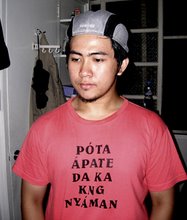
Alben meng manyaman, boy!

Showing posts with label Media. Show all posts

May 22, 2009

Kamaru photographs Palawan music video lead actors

Kalalangan Kamaru is currently in Palawan and will be back the 27th!

MODELS: JR Payuyo, Febbie Sabbaluca
LOCATION: Balsahan, Puerto Princesa City, Palawan

PHOTOGRAPHER: Diego Marx Dobles
POST-PROCESSING: Jason Paul Laxamana
LOCATION MANAGER: Jocelyn Fabello

Models will be the lead actors in the upcoming music video of "PLONING, ADIN KA REN" (Ploning, Where Are You) by Bulyaw Mariguen, a Cuyonon rock band. To be directed by yours truly.


May 19, 2009

Another [controversial] Filipino film at the Cannes Film Festival!

Brillante Mendoza: the “Love Him or Hate Him” Director
'Kinatay' stirs Cannes Film Festival

By Jason Paul Laxamana
Urban Kamaru
Central Luzon Daily


AFTER participating in the prestigious Cannes Film Festival last year with 'Serbis' -- a neorealist film about the Family Theater in Angeles City, San Fernando-born Brillante Ma. Mendoza is again vying for the main award, the Palm d'Or, in this year's festival with a violent film about the infamous “chop chop lady,” a grim character propagated by the news media in the late 90s. 'Kinatay' is also a co-production between Mendoza's Center Stage Productions and France' Swift Productions, the followup co-production after 'Serbis.'

The title of his latest work is 'Kinatay,' with English title 'The Execution of P.' Again written by Armando “Bing” Lao, 'Kinatay' is a story of a newly-married young police trainee who is need of more money to sustain his and his wife's education. To solve his problem, he goes with police officers to a clandestine mission of torturing a drug-addicted prostitute in Manila. Later on, the prostitute is mercilessly beaten, slaughtered, and chopped into bits, the parts wrapped in plastic, and thrown in various parts of Manila.

The movie, like in most Mendoza films, again stars Coco Martin. Mercedes Cabral, who played as the girl impregnated by Coco's character in 'Serbis,' is also back, along with Julio Diaz (also from 'Serbis'), and Lauren Novero (from 'Kaleldo'). The movie also stars Jhong Hilario, Maria Isabel Lopez, and John Regala.

Controversial again

As with last year's Philippine entry to the Cannes, 'Kinatay' has not failed to divide the audience and the film critics. There are those that brand the film as the worst entry in the festival, while others praise it for its unconventional style—no sensationalized scenes, slow rhythm, hand-held camera shots, absence of plot, lack of character development, and minimal lines. This is also partially thanks to the screenwriter, who is known to advocate for real-time scriptwriting.

This recurring style in Mendoza's films is what gets on the nerves of film critics who are not fans of the internationally acclaimed director. They describe 'Kinatay' as something that causes the audience alienation, resentment, and a feeling of having wasted money to see the film. Like in 'Serbis,' these critics also complain about the terrible traffic background sound which they describe as too noisy. Mendoza and Angeles City-residing producer Ferdie Lapuz both defend however that they are only trying to show the reality of noise pollution in the urban Philippines, which I couldn't agree more with.

The boldness of 'Kinatay,' on the other hand, makes it a probable choice in emerging victorious in the festival. Match, a German film distribution company, has picked up the controversial Filipino artwork for international distribution.


No more box office

Mendoza already knows that the films he loves to make aren't the films Filipinos want to see in theaters. That is why he just plans to hop from school to school to screen his films like 'Kinatay' to students, and then talk about the issue featured after the film. Such style of screening makes movie-watching more interactive, and makes education much more exciting than just being stuck in the classroom.

May 10, 2009

New Kapampangan rock music video - Happy Mother's Day!

Happy Mothers' Day (Masayang Kayaldawan da ring Ima) to all of our dear mothers! Before I left for the US, we were able to shoot the band scenes of Mental Floss' music video for their RocKapampangan song "Ing Lugud Ning Indu" (Love of a Mother). We really intended to finish the video by Mothers' Day, but sadly, we didn't.

So I'll just say: Abangan! Here are some screen captures from the video. If you notice, the vocalist is pregnant, too! She's soon to become a mother! Congrats, Nicole!


Meanwhile, here is an old video of Mental Floss performing 'Ing Lugud Ning Indu.' Don't you think it's a nice Kapampangan song?

May 1, 2009

Omegle.com: The Thrill of Chatting with Random Strangers

By Jason Paul Laxamana
Urban Kamaru
Central Luzon Daily

There are a couple of reasons we chat with people we don’t know online. Back when I was still a Yahoo! Messenger chat addict, I went to chatrooms the name of which sparked my interest, like “Atheist VS Christian chatroom” and “Tambayan Kapampangan,” carrying the assumption that I would have the opportunity of chatting with people who shared the same interest.

Some who entered the chatroom merely lurked (an Internet term which means to be a member of a chatroom or forum, but not shouting out anything; an observer of the exchange of messages instead of a participant), while some debated with, or even flamed (an Internet term which means to debate with argumentum ad hominem) people who held beliefs different from theirs. A frequent case in many chatrooms though, regardless of their topic, is the abundance of perverts, meaning people who go online and try to pickup anyone, and probably invite him/her to some SEB (sex eyeball), or the so-called cam-to-cam (cybersex through webcam).

Now how about joining a chatroom that sets you up a session with a random stranger from anywhere in the world?

Introducing Omegle

One of my time-killers in my recent vacation in California was logging on to this website called Omegle (http://omegle.com), which my big brother introduced to me. The introductory message of the site says it all: “Omegle is a brand-new service for meeting new friends. When you use Omegle, we pick another user at random and let you have a one-on-one chat with each other. Chats are completely anonymous, although there is nothing to stop you from revealing personal details if you would like.”

I personally found the concept appealing. You know, being paired with a random person in cyberspace. Questions popped in my mind such as: What country will he/she come from? What age? What school level, course, or job? What interests? Will he/she be worth my time? Thinking of all these variables whenever Omegle paired me with a chat-mate gave me excitement, and I have chatted with a variety of people so far—from an interesting linguist from London who knew stuff about the Filipino language, to a Han Chinese university student who was forced to take up English.

I had a long chat with the linguist from London, who was not surprised with my proficiency in English, since he knew about the status of English in the Philippines, a country which, he said (and I agreed) had “stupidly big malls for a third world country.”

Sometimes, chats become very interesting in that I would chat with them until the wee hours of the morning, and we end up adding one another in some social network website like Facebook, like that Canadian French student whose ambition is to become a famous literary writer in Francais someday, the Mexican girl who is into spontaneous photography, and an independent grunge musician from Holland who hated his country’s wintry weather.

Despite the global accessibility of Omegle (even China allows it), the countries where participants usually come from are the United States, Canada, Mexico, United Kingdom, Holland, Brazil, and China. The only Filipinos I know who use Omegle are me, my big brother, and my cousins in the United States.

Disconnecting, Jerks, and Perverts

But not every stranger is fascinating. In fact, the chance of being paired with an interesting person is slimmer than being paired with a blah person. The good thing though is that you can disconnect with your current session, and Omegle will then pair you with a new stranger. (You can’t chat again with the previous person you’ve chatted with because contacts are not stored unlike in Yahoo! Messenger; unless serendipity is by your side and you get paired with the person among all other users online from all over the world).

Many times, the first thing you chat-mate would ask you would be your ASL (age, sex, location). A lot of times as well, if the person on the other line is a typical guy, and learns that you are also a dude, he would then disconnect without explanation. But the obvious explanation is that he is looking for someone from the opposite sex.

There are those who disconnect after learning what country you come from, or after learning about your age.

I’m not trying to be a jerk, but I usually disconnect without justification when the person on the other line answers briefly with questions. Like when I ask about how it is going with his/her country, and he/she answers with only a word, I disconnect. I yearn for more articulate people who just want to have a nice chat about anything under the sun. Some, usually high school students who are 12 to 14 years old, aren’t just very worthy of my time. Hey, I have the freedom to be a jerk, too.

Sometimes, I play pranks with people, too when I feel like it. I pretend to be someone else and make up my own fictional character description. I already have pretended to be a single mother from Japan addicted to communist ideas, an intelligent American male hustler wanting to commit suicide, and even an alien medium from India proclaiming the arrival of the aliens from a faraway galaxy.

It’s a nice exercise for fictional writers like me, hehehe.

About the Philippines

I have this habit of asking my chat-mate if he knew where the Philippines is, because I have encountered a lot who didn’t know where it is. Some didn’t even know it was a country. One stranger from Belgium thought it was one of the states of the US. One thought it was in Spain.

So what are you waiting for! Let’s add more Filipinos to the Omegle community! Log on to http://omegle.com

Send reactions to sisig_man@yahoo.com.ph

April 21, 2009

Kalalangan Kamaru to participate in Cuyonon music video production

(posting this from Joey Fabello's journal)

The Ploning Adin Ka Ren Music Video Auditions

PURPOSE

Bulyaw Mariguen’s Songs are rock and acoustic songs in the Cuyonon language having contemporary society as the setting of each story within the songs. The stories in their songs represent a reality seen through the eyes of urban Cuyonons who are exposed to both traditional Cuyonon practices and rituals and to the effects of a globalized world. Their songs are also the first Cuyonon rock songs broadcasted, promoted and made available in Palawan through one album, thereby making Bulyaw Mariguen innovators of Cuyonon music.

Bulyaw Mariguen’s songs are the first of their kind. Promoting them to the Filipino community thus shows the Filipino community of the existence of the Cuyonons and their drive to be heard in a country monopolized by creative outputs in Tagalog.

GOALS

As a means to have Bulyaw Mariguen's Cuyonon rock and acoustic songs heard by and promoted to a greater number of other Filipino cultural groups (through music video channels broadcasted nationwide), Cuyonons (since a lot of Cuyonons has migrated to different parts of the country already) and Palawenos (since most Palawenos patronize national television), a music video of one of Bulyaw Mariguen's Songs, PLONING ADIN KA REN, will be shot in Puerto Princesa City, Palawan this coming May 2009.

PARTNERSHIPS

Through the help of the Palawan Broadcasting Corporation (DYPR TV PATROL, DYPR PALAWAN RADYO and IFM 99.9), Kalalangan Kamaru, the Iwahig Prison and Penal Farm, cuyopress.com and different individuals (the list of which is ever-increasing as we come closer to the shooting dates of the music video), matinlo productions is able to produce this music video (Ploning Adin Ka Ren).

CASTING CALL/AUDITIONS

Auditions for the lead actor and the lead actress of the music video have already started last April 18 and 19, 2009 at the DYPR Dance Studio (Mabini cor Valencia Street, Puerto Princesa City). Second Batch of auditions starts tomorrow (April 20, 2009) 1 to 3 pm at DYPR.

Should you be interested to contribute your skills for the said project, we are also looking for other individuals to form part of the cast of the music video. Please check the characters needed in the succeeding paragraphs.

THE CONCEPT

The Ploning Adin Ka Ren Music Video is not the usual music video that you see in music television channels. For one, the music video will have English or Tagalog (depending on the market) subtitles to make the songs understandable to the viewers of the music video. At the same time, the concept behind the music video is highly symbolic of what is happening to the Cuyonon culture and the struggle of the music of Bulyaw Mariguen to be accepted by the public who seem to condemn than support such innovations in music.

THE CAST

LEAD:

The Young Modern Ploning
Young Looking (around 20s look)
Good at acting
Experience in TV production (not required)
As long as she is easy to direct

LEAD:

Ploning’s Lover
Young Looking (around 20s look)
Good at acting
Experience in TV production (not required)
As long as he is easy to direct
PLONING’S MOTHER
CORPORATE PEOPLE
MAN IN SUIT OR IN POLO
WOMAN IN SUIT
TEENAGE GIRL AND BOY (ANIME LOOK)
STUDENTS
1 COLLEGE STUDENT (BOY)
1 COLLEGE STUDENT (GIRL)
1 HIGH SCHOOL STUDENT (BOY)
1 HIGH SCHOOL STUDENT (GIRL)
1 TEACHER- WOMAN
RELIGIOUS FIGURE
NUN
BABAYLAN
MUSLIM WOMAN
CLOWN (can perform simple tricks)
MUSICIANS
FOLK GUITARIST
POP GUITARIST
INDIGENOUS PEOPLE
SOMEONE WEARING AN ALAKAYO MASK COVERED IN BLUE DYE (ANYEL)
TAO’T BATO
TAGBANUA (MOTHER AND CHILD)
TAUSUG- FEMALE

NOTES:

It must be noted that the production team took gender issues into consideration. See Religious figure and the attempt to represent girls and boys in most groups. It must also be noted that the indigenous groups chosen to be part of the INDIGENOUS PEOPLE cast are those who can be found in Palawan.

LOCATION


The location of the music video is at Balsahan managed by the Iwahig Prison and Penal Farm. (Thank you for letting us use the location for free...!)

THE PRODUCTION TEAM

The production team behind the music video is composed of people from different production teams such as matinlo productions and KALALANGAN KAMARU and different individuals who are interested to contribute their skills for the production of the music video.

Matinlo productions is owned by Joey Fabello and in this production absorbed the responsibilities of a Producer and a Production Manager. The director and the assistant director of the music video came from Kalalangan Kamaru.

The director of this music video is a multi-awarded Kapampangan director and cultural advocate. He bagged the First Philippine Digital Award in short film category from the Entertainment Channel (ETC) this year, is the director of the First Ever Kapampangan Telenovela in the Philippines (Kalam) and the director of the music video of Mernuts entitled Oras, seen at MTV Pilipinas. He was also the one who spearheaded the Rockapampangan Project together with Holy Angel University.

A detailed list of the cast and the production team will be made available in the succeeding pages. If you are reading this entry from a different site, please visit our official blog site at http://www.bulyawmariguen.blogspot.com/. Also, if you know someone who might be interested to be a part of the cast and or the production team, please contact Joey Fabello at 09276275554 or Mares Krishnaa Bajar at 09085421141 or please forward this entry to them.

MATAMANG SALAMAT, WE NEED YOUR SUPPORT! SEE YOU AT THE AUDITIONS!

April 18, 2009

Sandara Park: Jologs in the Phils, Kinda Cool in Korea

So I was randomly watching East Asian music videos when I encountered a song called "Lollipop" by a popular Korean boy group called Big Bang (songs of which I have in my MP3 player currently), featuring a girl group called 2NE1.


I was watching the video, it was kinda bubblegum-pop/hiphop cool. But one of the members of 2NE1 was somewhat familiar in my brain. Then, in the middle of the music video, I had this thought:

She friggin' looks like Sandara Park (of Star Circle Quest fame, partnered with Hero Angeles and Joseph Bitangcol)!

So I researched on the girl group, and boom! It's Sandara "Dara" Park!

To like Sandara Park as a singer/dancer ('Sumusunod') in the Philippines is kinda jologs or uncool, but look at her under YG Entertainment (Korean label)! She's kinda cool.

Just goes to show that a lot of Philippine producers are baloney. I am nationalistic and all, and have always believed that Pinoy artists have what it takes, but our producers are just too mediocre to send a Philippine wave abroad. Sorry.

March 13, 2009

BALANGINGI (Nosebleed) WINS @ PHIL DIGI AWARDS!


1:30 am.

Just got home!

World Trade Center, Metro Manila—our Kapampangan short film Balangingi (Nosebleed) wins the ETC award for best short film at the 1st Philippine Digital Awards! Dakal a salamat pu!

I'd love to elaborate, but, sorry, I need to rest for now.Have to return to manila tomorrow/later for Cinema One Originals 2009. I'm submitting a screenplay there, too.

Para king Indung Kapampangan!

(L-R): Jason Paul Laxamana, Writer-Director-Editor of Balangingi, etc.; Jayvie Dizon, lead actor; Jeremy Cortez, dubbing assistant; Diego Marx Dobles, Asst. Director-Music Scorer-Location Manager, etc. Photo was NOT taken during the Awarding. Photo was taken backstage after the last run of Oedipus Rex at the Angeles University Foundation, where Dizon played the lead role as well.

March 8, 2009

'Balangingi' is Jack TV/ETC short film category finalist

I was told just minutes ago that my Kapampangan short film Balangingi (Nosebleed) is a finalist in the Philippine Digital Music & Short Film Festival.

Jack TV and ETC have joined Isys business solution and Blue Fish Asia in the Phil Digi Awards. The Stylish and posh ETC and the Outrageous and Manly Jack TV channels launched their new categories in the Phil Digi Awards Short film competition. The Jack Short Film Category and ETC Short Film Category are the latest addition in the Phil Digi Awards Short film Competition.
Jack TV is looking for chic, witty and funny short films, may it be with a Live cast or better yet an Animated one as long as it can tickle the funny bones and can made a ton of laughs, it's a sure ball for the Jack TV Short film category. ETC on the other hand is looking for reality based Short films, so for those who has a keen and sassy eye for making reality based Short Films, the ETC Short film category is for you.


Since people love Balangingi (and it seems it's effective as comedy), we decided to make a 15-minute version of it and submitted it to the Jack TV category. I don't know how the screening committee reacted to it, especially since it's in Kapampangan, but, uyta, it's a finalist.

It will be a two-day event, but I might be attending just the second day (even though I also want to attend the first day, which has a series of discussions on artist management and other stuff about commercial music, an area I would love to know more about).

The second day, the program will be more of a film and business forum:

8:00 – 9:30 Registration
9:30 – 10:00 Opening Ceremony
Opening Remarks
10:00 – 10:30 Trends and Opportunities in animation
10:30 – 11:00 Producing an Original Content in Animation
11:00 - 11:30 Setting up your own Business in Animation
11:30 – 12:00 Animation Open Forum
12:00 – 1:00 Screening of Short Film Entries
1:00 – 1:30 Movie copyrights and Publishing Rights
1:30 -2:30 Producing an original film contents
2:30 - 3:00 Finding Grants
3:00 – 3:30 E Commerce
3:30 – 4:00 Broadcasting and Marketing your Content
4:00 – 4:30 Film Business Outsourcing through the internet
4:30 – 5:00 Trends and Technologies in Film Making

At 8PM of March 12, it will be the awarding of the winning entries of PhilDigi Awards. The event will be graced by the presence and performances of Heber Bartolome, Dulce, Hilera, Typecast, Session Road, Zelle, Moonstar 88, Yosha, DJ Benjo and more.

I'm after the screening of the finalists, because I enjoy observing the reactions of people. Balangingi proved to be effective to Kapampangans; now let's see it fare in Manila. I'm not sure though if many people will be watching, but nonetheless, it's something I'd like to see.

February 24, 2009

"Ding Musa Ning Minalin" documentary

Kalalangan Kamaru presents its second Kapampangan documentary titled Ding Musa Ning Minalin (The Muses of Minalin). Made in a non-traditional no-commentary format, the documentary seeks to present to the world this unique happening in the quiet town of Minalin every New Year's Day.


For Minalenyos, New Year's Day is not just about firecrackers and noise barrages. It's also about real men dressed in gowns. Watch the documentary here:


Director, Editor: Diego Marx Dobles
Exec Prod, Subtitles: Jason Paul Laxamana
Camera: Dobles, Laxamana
Prod Assts: Bevs Esguerra, Thea Lelay
Local Coordinator: Jon Juico

February 22, 2009

The Curious Case of Kapampangan Cinema

A personal account of a Cinema Rehiyon participant
By Jason Paul Laxamana
Urban Kamaru
Central Luzon Daily

Cinema Rehiyon was held last week at the Cultural Center of the Philippines (CCP). It is the NCCA’s (National Commission for Culture and the Arts) Cinema Committee’s event for the then-called National Arts Month, now Philippine International Arts Festival (PIAF).

Cinema Rehiyon is the first ever film festival in Manila that puts the spotlight on independent films from the regions. Since the concept of Philippine Cinema has for long been Manila-centric, it is now time to decentralize it and take note of the more politically correct perception of Philippine Cinema—a collection of films from every corner of the archipelago, may they be indie or mainstream.


No Kapampangan participation

I make this personal joke—unfunny to some, probably—about Kapampangans naturally lacking the letter H in their speech. Despite this, it is ironic that they seem to be more involved with the Hearts’ Month during February instead of the Arts Month.

When the press release for the lineup of events for the PIAF was released, along with the focused provinces and cities of Cinema Rehiyon, I felt very bad because Kapampangan had zero participation.

“This is a showcase of nascent cinema from the regions. From the highlands in and around Baguio to the heart of Bicolandia that is Naga City; across the thriving Visayas cities of Cebu, Bacolod and Iloilo; and through Mindanao between Cagayan de Oro and Davao, a new generation of artists is telling stories of their own cultures and people in cinematic form.”

Being a Kapampangan indie filmmaker, I at once called the NCCA Cinema Committee and inquired whether the Kapampangan region can be represented by one of our short films—Ing Bangkeru (The Boatman).

No solid block

After more than a month of deliberation, they decided to include our film in the lineup, albeit categorized under the ambiguous “Short Films from Various Parts of Luzon” block. Our film shared space with a Laguna short film, a Batangas short film, and a Nueva Ecija short film—all Tagalog entries.

Enviable are the regions/provinces/cities that enjoyed a more definite block: Cebu short films, Bacolod short films, Cagayan De Oro short films, Central and Western Mindanao short films, Davao short films, Bicol short films, Baguio short films, and Iloilo full-length films.

Being the only Kapampangan during the festival, I actually felt lonely, seeing Cebuanos, Dabawenyos, Bicolanos, etc. come in numbers with lots of films to offer for the festival, speaking with one another in their respective languages.

It’s really tragic because Kapampangans have always played their part in national history (two sunrays in the Philippine flag are Kapampangan provinces), even in the field of arts. The CCP, where the festival was held, even has two areas named after two Kapampangan artists: Vicente Manansala and Aurelio Tolentino. Yet during Cinema Rehiyon—a historical event in the history of Philippine Cinema, I must say—we looked like a dying cultural minority, despite being one of the major ethnolinguistic groups of the country, and being one of the most progressive provinces in the country to date.

Alive after all...

Come to think of it though, an exclusive Kapampangan block could have been made. Aside from our “Ing Bangkeru” and our numerous other works (documentaries and music videos), there’s “Pupul” (Harvest) by Nicolette Henson, which bagged best narrative in her production class under Pam Miras at St. Scholastica’s College. It also made it to the Top 10 of the Short Narrative category of the Ateneo Video Open 10.

Then of course we have Mark Dela Cruz’ “Misteryo Ng Hapis” (Sorrowful Mystery), a full Kapampangan short film which enjoys several titles under its sleeve, including Best Picture in a recent year’s PBO Digitales, Best Thesis during its time at the UP Film Institute, Finalist in Cinemalaya 2007’s short film category, and Finalist in a recent Ateneo Video Open. It also competed in Cinemanila years ago. Following the trend is UP Film student Jacqueline Nakpil’s “Ke Lual Ning Kulambu” (Outside the Mosquito Net), her production thesis in 2007

Kapampangan full-length films are also existent. We have the internationally award-winning Kapampangan films of Brillante Mendoza like “Masahista” (The Masseur; City of San Fernando), “Kaleldo” (Summer Heat; Guagua), “Manoro” (The Aeta Teacher; Sapang Bato, Angeles City), and “Serbis” (Service; Angeles City). Although Mendoza’s Center Stage Productions is Manila-based, most of his actors and staff are his kabalen when he does Pampanga-based films. I should know; I have worked for him.

The Cinemalaya Best Picture of 2008 “Jay” (Bacolor), directed by Francis Xavier Pasion, can also be included. Even though the Manilenyos’ participation in the creation of the film was inevitable, most, if not all, actors actually hail from the province, as the auditions were held at DHVCAT in Bacolor. Even the lead actors, Baron Geisler (Angeles City) and Coco Martin (San Fernando), are Kapampangans.

But here’s the problem...

Despite the presence of these Kapampangan films, which are just as good as—or even better than—the other blocks I’ve seen during my three-day viewing of Cinema Rehiyon blocks, why have the organizers failed to detect us?

I know why. It’s because these Kapampangan films are not organized, unlike in Davao, Cebu, Bacolod, Iloilo, and other areas. Kapampangan productions sprout here and there, in various competitions, in various places, from Manila to Pampanga. They have all been individual efforts by various filmmakers who represent only themselves or their schools, not their homeland; filmmakers who are not yet well organized into a Kapampangan film community.

Most of the time, the people behind these Kapampangan films don’t even know the presence of other Kapampangan films, because each filmmaker is busy with his own career, flying solo either to Manila or abroad to propagate his/her own film, without thinking “I’m representing Kapampangan cinema.”

Is selfishness the root of this? I actually don’t think so.

The root

With conviction, I believe that the root of this is the deterioration of our people’s sense of being members of the Kapampangan community. The Kapampangans’ imagination of themselves as an equally distinct group like the Warays, Ilocanos, and Cebuanos is fading away, with Kapampangans, especially the talented ones, preferring to join the so-called Filipino community, which is actually just the Manila community.

While Kapampangan Cinema is a thing yet to be born, Kapampangans are actually not newbies in the industry. Manila has always employed the skills of Kapampangans—whose homeland is very near—in developing their film industry (and other industries as well): from Rogelio Dela Rosa to Gracita Dominguez; from Gregorio Fernandez (directed “Asahar at Kabaong,” “Senorita,” and “Higit Sa Lahat,” which won for him Best Director at the 1956 Asian Film Festival and also at the FAMAS) to Lea Salonga.


From Elwood Perez to Brillante Mendoza; from Patsy to Chuck Perez; from Lito Lapid to Liza Lorena; from Sharon Cuneta to Judy Ann Santos; from Paquito Diaz to Rodolpho “Dolphy” Quizon (born to Kapampangan parents in Pampanga but raised in Tondo); from Alma Moreno to Jaclyn Jose; from Hilda Koronel to Rosita Noble.

From Melanie Marquez to Dong Puno; from Dante Rivero to Rufa Mae Quinto; from Efren Bata Reyes to Lorna Tolentino; from Rudy Fernandez to Jean Garcia; from Nanette Inventor to Donita Rose; from Glydel Mercado to Rico Puno; from Ronnie Liang to Aljur Abrenica; and many more, and still progressing in number.

These are probably things not even national historians of Kapampangan descent like Ambeth Ocampo would be interested in tracing.

Local brain drain

While it seems nice that Manila has catapulted our kabalens to “national” status in the entertainment industry, what suffered actually is the Kapampangan community in general, as these Kapampangans who have been absorbed by Manila mostly have become assimilated to Tagalog culture, stripping away their “Kapampangan-ness” and their potential to represent the Kapampangan people.

A vivid example is probably Rogelio Dela Rosa, discovered by no less than the Father of Philippine Movies Jose Nepomuceno. Dela Rosa had a problem when the era of silent films was through—he had a very strong Kapampangan accent when delivering his Tagalog lines. But Dela Rosa worked so hard to master the Tagalog language, and later on, he was given a new break in the movie “Diwata sa Karagatan,” the first Filipino feature film sold outside the country.

It’s time for Cinekabalen

We have served the Manila film industry well and became instrumental in the propagation of Tagalog culture and language through cinema. Now, I guess it’s time to look back, even just a little, to our dear Kapampangan homeland and try to keep up with the rest of the country in producing local films—even just indie—that genuinely depict our native culture (both rural and urban) and imagination, using our own “de-Manila-tized” perspective. Because if Kapampangans won’t do this, no other region will do it for us.

This August, the first Cinekabalen Philippine Film Festival will be organized. It will not only exhibit existing Kapampangan works but also place in competition fresh Kapampangan works from participants, may they be students, professionals, mere enthusiasts, or ex-patriates. The mechanics can be found at http://cinekabalen.multiply.com.


To expose the Kapampangan audiences—most of whom believe that being assimilated to Manila’s pop culture is the way to go—to the impressive indie filmmaking efforts of other regions, Cinekabalen will also screen selected films from other regions in the Philippines, like Cebu, Davao, Bicol, Iloilo, Kalinga, Eastern Visayas, Bacolod, and Muslim Mindanao.

Actually, student short film competitions have been held in key colleges for the past years already, such as the Holy Angel University and Systems Plus College Foundation. Some have been technically competent. A major problem however is their “cultural confusion.” Their stories are not rooted to their homeland. They echo the stories of Manila, the way they see them on Manila and foreign TV shows and movies. The writers imagine too much melodramatic things and fail to see the beautiful local stories unfolding around the neighborhood.

All their characters speak Tagalog and English, and deliberately eliminate Kapampangan out of the picture because subconsciously Kapampangan is not as prestigious as the two official languages for them. Language is important in any cultural product that involves language. This is especially true for Kapampangan; anthropologist John Larkin mentioned in his book “The Pampangans” that Kapampangans share a lot of common culture with nearby ethnic groups, and their distinct language is one of the things that strongly sets them apart from the others.

Cultural farsightedness

I was chatting once with a college IT student, asking him to participate in the Cinekabalen short film competition this August. He said he would love to join, but told me he is not a good writer and does not know how to make stories.

So I chatted with him about life in general, until he casually revealed to me that he is a Muslim, converted from Christianity back when he was young. Within the Muslim community, however, “Muslims since birth” tend to regard themselves higher than “converted ones” or the so-called “Balik Islam.” Also, even though he was Muslim, he attended Catholic schools.

Then I told him—“There’s your story! You don’t have to imagine a lot of things in order to come up with a beautiful work.” I sounded sensible to him, and he got all excited about the concept (which came from him anyway), and told me that he WILL be participating. He got even more excited when I told him that the Muslims of Pampanga have never been tackled in any Kapampangan film.

This “cultural farsightedness” by budding writers and filmmakers is shared by many Kapampangans. For example, in the school paper of one university in Angeles City, a writer came up with the major highlights of the Year 2008. He cited the victory of Obama, the release of this Hollywood movie (“Twilight”), the end of season two of that TV show, the new album of this artist, the Eraserheads concert, Pacquiao’s victory over Dela Hoya, etc.

He didn’t consider the major happenings in Pampanga as highlights of 2008—the recall move against Governor Eddie Panlilio which has been getting national attention, the celebration of the first ever province-wide “Aldo Ning Amanung Sisuan” or Kapampangan language day, the release of the first ever Kapampangan rock album, the rise of Ara Muna (“O Jo, Kaluguran Da Ka”) to national fame, the production of the first ever Kapampangan TV drama (“Kalam”), the Cannes Film Festival participation of the Angeles City film “Serbis,” and the winning of “Jay” in Cinemalaya 2008, to name a few.

A reward-system shift

The question now is: how do we cure this illness? I believe it will take the introduction of a Kapampangan-glorifying trend to Kapampangans themselves for this to happen. Hopefully, Cinekabalen will contribute to the propagation of this trend.

Also, it would be highly appreciated if our public officials, academes, and successful entrepreneurs financially aid indie filmmakers who would knock on their doors for the production of their respective Kapampangan works. I believe part of the impressive output of Davao indie filmmaking community is due to the support of the more financially-blessed citizens of their place, like Mayors and businessmen.

Please email reactions to sisig_man@yahoo.com.ph

Old photos of Kapampangan stars care of Alex Castro.
February 17, 2009

The 1st Cinekabalen Philippine Film Festival

Makiabe na ka!

It is time for the Kapampangans to participate in the next wave of Philippine Cinema by holding its first ever Kapampangan Film Festival! The Cinekabalen Philippine Film Festival will be an annual event that will aim:

• To make people, especially Kapampangans, aware of the existence of Philippine Kapampangan cinema and to celebrate the capability of Kapampangans to make films
• To encourage Kapampangans, especially students, to make films that tackle the Kapampangan experience
• To promote the patronization of the Kapampangan language for aspiring filmmakers
• To hone the skills of aspiring Kapampangan student filmmakers through seminars, lectures, and workshop
• Provide a venue for aspiring competent filmmakers to showcase their work/s
• To organize a cooperative film community or network among the Kapampangans, especially universities with communication courses

The highlights of the festival will be: 1) the screening of Philippine Kapampangan full-length films, short films, music videos, and documentaries; 2) panel discussions on indie filmmaking; and 3) a short film competition.

Rules and mechanics of the short film competition:

- everyone is allowed to join (no age limit), except members of the core organizing committee

- animated entries are also allowed

- no music videos, only narratives

- no limit of number of entries

- dialogues must mainly be in Kapampangan

- setting of the story does not necessarily have to be in Pampanga or other Kapampangan-speaking regions like Tarlac and Bataan

- film must have English subtitles

- strictly 10-20 minutes in length

- in digital format (submit final work in playable DVD)

- any topic is allowed

- extreme violence and obscenity and unnecessary abuse of foul language are discouraged

- use of copyrighted music is not allowed

- deadline of entries (final DVD, registration form) will be on July 31; they must be shipped or submitted in person to the Juan D. Nepomuceno Center for Kapampangan Studies, Holy Angel University, Angeles City

- 8 to 10 finalists will be chosen (depending on the quantity of submissions) to compete in the festival; prizes are at stake for the top three best short films; special awards (best male performer, best editing, best screenplay, etc.) will also be given


Inquiries: text JASON @ 0918 699 2459 or email sisig_man@yahoo.com.ph

Visit: http://cinekabalen.multiply.com

February 16, 2009

A review of the Filipino Kapampangan film “Jay”

Exposing the Dark Side of Public Service TV Shows
By Jason Paul Laxamana
Urban Kamaru
Central Luzon Daily

Weeks ago, another independent film, directed by a Manila-raised Kapampangan, Francis Xavier Pasion, was screened in SM Cinemas. It can be remembered that the film “Jay” has been chosen as the best film of Cinemalaya 2008 Full-length Category for its interesting story and almost flawless execution. Recently, it has also participated in various film competitions abroad, making it one of the best Filipino films of 2008.

“Jay” tells the story of two Jays—one a high school teacher in Pampanga who was stabbed to death in Manila by a masseur (let’s call him Jay 1), and the other, played realistically by Baron Geisler, an aggressive and equally homosexual field reporter for a TV station called Channel 8 (Jay 2). Jay 2 works for a program that features people who have been slain unjustly, and in the film, that victim is the teacher Jay.


The impressive detail of the film can probably be greatly attributed to the director, who has been working in broadcast media before deciding to cross over to film. As an insider, he should know the dark side of public service TV shows.

The Kapampangan Setting

The film is set in the less progressive parts of Bacolor, Pampanga, and a few scenes in Manila, where Jay 2 resides. If one would see the film and take it as the sole representation of Pampanga in the world of Philippine cinema, we would think that the province is all throughout a poor town buried under lahar, with backward-minded people going crazy over the presence of Manila media people.

The San Guillermo Church of Bacolor makes another appearance, the first being in Brillante Mendoza’s ‘Kaleldo.’ A local school, the name of which I am not very sure of (I think it was DHVCAT), where Jay 1 was supposed to be teaching was shown as well.


There were a few main Kapampangan dialogues and ambient Kapampangan dialogues in scenes that featured public places such as the funeral. If we are to listen carefully, we would hear that the ambient Kapampangan dialogues are just being repeated over and over—which is fine. I only find it amusing because I noticed it.

Manila and Manipulation

Like ‘Masahista,’ ‘Jay’ is another film that shows how Manila does the bad “F” word to Pampanga. The catch of the film is that Jay 2, a media worker from Manila, manipulates the whole happening for it to be dramatic enough to be featured on television, in the disguise of public service.

The respondents of interviews, on the other hand, contribute to the dramatization of the whole crime, by exaggerating their emotions in front of the camera—a proof that Manila media have turned us into soap opera actor-wannabes feeling all sorts of pressure when a video camera is pointed at us, as if we are auditioning to another season of Pinoy Big Brother.

The film starts with a TV documentary that reminds us of shows like ‘Wish Ko Lang’ and ‘Lukso Ng Dugo.’ It tells the life and clean reputation of Jay 1 as a teacher, as a friend, as a lover, as a son, and other roles he animates in society. It also shows the painful expressions of sadness by people who hold Jay 1 dear, including a Mayor who mightily declares justice for the murderer.

After the documentary, we are actually exposed to how the documentary was produced. We are taken to scenes where Jay 2 adds and/or omits pieces of truth from the interviews in order to compose a good episode for his show.

For instance, the weeping of the mother when she first saw the dead body of her son was actually a third take. The first take—which was the genuine coverage—had some technical problems, so Jay 2 had to ask Nanay Luz to re-enact the weeping. Another omission of reality was the reason the masseur (played by JC Castro of Angeles University Foundation) stabbed Jay 1 to death—Jay 1 tried to sodomize him. We see Jay 2 telling his editor to take away that part because it’s not for general patronage.


We also see Jay 2 becoming close to his respondents, such as Nanay Luz, Jay 1’s sister, and the shy straight-acting secret lover of Jay 1, played believably by Coco Martin—only for us to realize in the long run that Jay 2’s motive is to extract more controversial pieces of information from them to sensationalize his story more.

It was shown at the end of the film that Jay 2 is not really concerned with the plight of the less fortunate—that his public servant image is just part of his profession. After work, he’s an ordinary person passive of the issues of society. Jay 2 is being begged for money by a street kid, whom he shoos away with bad temper. I believe this is a character that represents many of well-known personalities who project themselves as beacons of justice and public service on mass media, but in truth are mere self-centered laborers of society.

Pampanga Projected

‘Jay’ is another addition to the growing roster of Philippine Kapampangan films, and I am very proud that they have all been making waves in NCR and abroad. The only challenge now is for these films to make waves in their hometown: Pampanga. When I, along with two friends, watched the film at SM Clark, there were only five of us in the cinema.

Yet again, ‘Jay’ is another addition to the growing roster of Kapampangan films that project Pampanga as a hub of backwards people who have been living mundane and traditional lives ever since the 1991 Pinatubo eruption. So now, I am still waiting for the full-length Filipino Kapampangan film that would tackle the urban life of Kapampangans. It would sure diversify the collection, don’t you think?


Ferdie Lapuz, the distributor of the film (and the distributor of most of Mendoza’s films), told me that Pasion’s next film will be about the Malaya Lolas—that group of women raped in Mapaniqui during the Japanese occupation, but only came forward to tell their story recently. A Kapampangan period film—now that’s interesting!

Images care of Paolo Feliciano.

February 8, 2009

Brillante Mendoza’s ‘Manoro’ and the Captive Audience

Last January 31, despite the students of Holy Angel University celebrating their annual U-Days, many of them—about a thousand—were required to attend the screening of two of Brillante Mendoza’s alternative films, the first of which was ‘Manoro’ (The Aeta Teacher). I believe it is the first ever film that featured the aborigines of the Philippines and the first film to get Aytas as the main cast. Plus, the language is 95% in Ayta language (that type which is spoken in Sapang Bato, Angeles City, where the setting of the film is), 3% in Kapampangan, and 2% in English.


The story is set during the presidential election time which pitted Gloria Macapagal Arroyo against Fernando Poe, Jr. and Ping Lacson. Having graduated from elementary, a young Ayta girl named Jonalyn Ablong took the initiative to teach the elders of her tribe how to basically write the possible ballot entries—GMA, FPJ, or LACSON—to allow her people to participate in the democratic process.

In the end though, Jonalyn learned that it ain't as easy as it seems, as many of her tribesmen prefer to gather food than to “waste their time” voting. Enthusiastic ones didn’t find voting easy as well, as some of them are not in the list of registered voters, and some couldn’t recall properly how to write their ballot entries during the election itself.

I have first watched this film in Quezon City back when I was a college student year 2006. Checking out the cinemas to see what movie to watch, I came across the poster containing an Ayta girl holding out a blackboard like a teacher with elder Aytas surrounding her, listening intently like obedient grade school students. Upon seeing that it was a co-production with Holy Angel University and that it was part of the Digital Lokal competition of the Cinemanila Film Festival, I bought a ticket.

Oh, and let’s not forget that it was a Brillante Mendoza film after all, and knowing his excellence in filmmaking and impressive cultural detailing in his movies, it was impossible for me not to watch. Later on, ‘Manoro’ would win the Digital Lokal competition and the film, like Mendoza’s other films, would impress film fest audiences from around the world—from Rome to Torino.

Almost Empty Seats

There weren’t many of us inside the cinema at SM when I watched ‘Manoro,’ and we can expect this from alternative films, especially those which do not possess well-known actors in them. In my observation, the only films that can draw a relatively big audience in spite of casting unknown characters are films that have enough nudity in them—mostly male; films that objectify young and sexy studs to the delight of a rowdy gay and bisexual viewers.

The second time I watched ‘Manoro’ was in Robinson’s Indie Sine, a sanctuary for alternative film, with two friends whom I often speak with regarding culture and film as tool in empowering the marginalized. Also watching were Kidlat Tahimik—the Father of Philippine Independent Cinema—and his equally long-haired son, whom we are facially familiar with because he is an alumnus of our organization in the UP College of Mass Communication.

Even though Kidlat Tahimik was very impressed with the film like my friends, I couldn’t help notice the pitiful number of viewers inside a cinema which can cater to about 300 to 500 pairs of eyes. Evidently, Filipinos are not ready for these kind of films, especially because ‘Manoro’ is shot in neorealist treatment, making it seem like a documentary even though the whole thing is scripted. In one festival abroad, Mendoza even claimed that the organizers categorized ‘Manoro’ under the documentary category, not knowing that the film was actually a fictitious narrative but strongly based on actual research.

Captive Audience

This is no surprise even for Mendoza. Before the film was screened at the auditorium of HAU, the director admitted that he was expecting the film to probably bore the students. Robby Tantingco, Director of the school’s Kapampangan Center, had the same fear. Alas, both of their expectations were right, as the viewers began sinking in their seats like siesta-taking folks, as the film proceeded to the parts that showed Jonalyn and his father taking long treks in the mountains in search for Grandpa who went out to Apo-Namalyari-knows-where to hunt.


I was even hearing the students seated close to me asking, “Maluat ya pa kaya?” Being average students, I assume, they were not interested to follow the story at all and were just waiting for the film to end. After all, they were there as captive audience, a term which I heard from Jim Libiran, director of Cinemalaya 2007’s ‘Tribu,’ who was a panelist in Marilou Diaz Abaya Film Institute’s “Mainstream Loves Indie” at Antipolo.

In harsher words, they were forced to pay fifty pesos, watch the movie, and perhaps whip up a decent reaction paper that would fulfill their partial requirements in their respective classes.

Who’s at Fault?

In such situations, who is at fault? The audience, whom intellectual snobs would brand as people who need to be smarter in order to comprehend such wonderful pieces of art like ‘Manoro,’ or the director and/or producer, who is so eager to explore his neorealist style, forgetting the psychographics of the mainstream-dazed audience?

As a director, Mendoza stands by his artwork. Even though he expects a lot of people to not understand the point of his films, he believes that as long as he can touch one or two people from his audience and cause them to think and act upon going out from the theater house, he has already achieved something. But if he shifts to producer mentality, of course, the filmmaker can be blamed, because of his failure to communicate the idea interestingly to their target viewers. The producer then is also at fault because he allowed that to happen.

But who are the target viewers of ‘Manoro’ anyway? Is it the Filipinos? Is it the cinephiles of other countries? Is it the people with the same concept of art or film as the director? The success of the producer really depends on the answer to this question.

Don’t get me wrong, however. ‘Manoro’ is one of the best Philippine films for me, as one can see in the Favorite Movies section of my Friendster account. But things become dimmer upon taking into account the reaction of the masses, the opinion of whom I value so much in the film industry. After all, that's one of the subject matters of the Ayta film—democracy.

January 29, 2009

My Kapampangan short film @ CCP this Feb!

February is heralded the National Arts Month in the Philippines, and because of this, there is a huge Philippine International Arts Festival to happen in the whole month of Feb.
"The National Commission for Culture and the Arts (NCCA) is making an innovation in the usual National Arts Month (NAM) it has been organizing in the past 18 years. Beginning this year, the NCCA will start calling it the Philippine International Arts Festival. The talents of Filipino artists will be presented while at the same time promoted to the rest of the world. Artists from all over the Philippines will join the events of the PIAF. Local governments and arts groups will also take part with this event, thanks to funding from the NCCA. This year's theme is Ani ng Sining. Instead of celebrating only in Manila, numerous events are slated to happen in Luzon, Visayas and Mindanao."
One of the events will be Sinerehiyon. This is a showcase of nascent cinema from the regions. From the highlands in and around Baguio to the heart of Bicolandia that is Naga City; across the thriving Visayas cities of Cebu, Bacolod and Iloilo; and through Mindanao between Cagayan de Oro and Davao, a new generation of artists is telling stories of their own cultures and people in cinematic form. This will be from February 17 to 19 at the CCP.


Representing Kapampangan cinema is this short film I wrote and directed Ing Bangkeru (The Boatman)! We're gonna go there to see our work screened at a national event! Glory be to the regions!

January 28, 2009

The Screening of Brillante Mendoza’s ‘Kaleldo’

And the Surprising Kapampangan Alternative Cinema Audience

Last 23rd of January, the Holy Angel University screened ‘Kaleldo’ (Summer Heat), one of the internationally award-winning films of Kapampangan alternative filmmaker Brillante Mendoza (2008’s Most Outstanding Kapampangan awardee for Mass Media) which like his other films exhibit a great deal of Kapampangan culture.


Even though I have already watched ‘Kaleldo’ in several cinemas and have viewed it over and over through my VCD player (yes, I bought an original VCD), I still made it a point to be there during the screening to observe how the students of Holy Angel University would find the film. Being bombarded with Hollywood- and Manila-produced movies in our local cinemas, it may be concluded that Kapampangans in general are still unaware of this thing advocated by Mendoza called alternative cinema, which does not rely on formulaic plots and glossy factors.

Mendoza the Advocate

Alternative cinema most of the time slaps social truths right in front of our faces. Even though we are immersed in these truths, we get so absorbed in them such that we are eventually inclined to ignore them. Instead of promoting escapism among the audience, it seeks to remind the viewers that the presentation of truth—regardless whether saddening or to be proud of—is another important function of films. This Mendoza realized when his debut film ‘Masahista’ was shown in Switzerland (where it eventually won the Golden Leopard Award in the video category). As he stated in hi speech before the screening, “I have come to realize how powerful a film can be.”

Right now, Mendoza is more than a filmmaker and a producer; he’s an advocate. He shows his films to various universities in Pampanga and shares the beauty of alternative cinema, hoping to spread the ideology to Kapampangan students for them to eventually widen their taste in movies—something which I believe my fellow kabalen are still lacking.


I am hoping as well that through the screening of Mendoza’s films in Pampanga, aspiring indie filmmakers, especially students, would learn to localize their content and be observant of their immediate surroundings, instead of trying to mimic what they see on television and pirated CDs. One clear sign of this is the preference of student filmmakers to use Tagalog as the medium of their films, even though all the characters seem to be Kapampangans. Goodness, I even know of one film which used 100% English as medium!

The film ‘Kaleldo’

‘Kaleldo’—which in Kapampangan means summer, but the English title is ‘Summer Heat’—is the story of a family in Guagua ten years after the eruption of Mt. Pinatubo. The story focuses on the three sisters: Grace (Juliana Palermo), the youngest among the three who is freshly wed to a Mama’s boy type of guy; Lourdes (Angel Aquino), a career-oriented and aggressive woman who is having an affair with a bank manager; and Jess (Cherry Pie Picache), the butch-type lesbian maker of atchara, who is also the eldest among the sisters.

The film is divided into three chapters, depending on the character on focus: Angin (Wind) for Grace, Api (Fire) for Lourdes, and Danum (Water) for Jess. Each element artistically represents the personality of the character and the mood of the chapter.

Even though the film is, as Mendoza described, “audience-friendly” because of its dramatic treatment, ‘Kaleldo’ can still be classified as alternative because it is not the type that would entice an average moviegoer to buy a ticket to. The actors are not exactly stars that have blind fanatics patronizing them in any activity they pursue unlike Sharon Cuneta, Aga Muhlach, Richard Gutierrez, or John Lloyd Cruz. The topic of the movie is not really something that would tickle the average man’s senses unlike the usual love stories and sex comedies of Star Cinema, GMA Films, Regal, etc.

Strange Kapampangan Audience

Strange—this was the adjective that appeared in my mind after observing the general reaction of the audience to ‘Kaleldo.’ Was I too judgmental? Honestly, I thought the Kapampangan students, who are not very exposed to indie films, would get bored with ‘Kaleldo.’ Yes, their “mababong kaligayan” was still evident, in that they made big deals over what I consider insignificant things in films such as butt exposures, local bad words, sex scenes, and homosexuality, but they likewise enjoyed the other serious scenes as well.

Could it be because the film exposes Kapampangan culture and we could relate? Could it be that reality is charming after all, in that being reminded of it (reality is buried in our subconscious, thanks to the escapist effects of mainstream movies) sends us laughing while thinking “so true, so true,” unlike the slapstick and corny jokes of Tagalog comedies?

Actually, even our short film ‘Ing Bangkeru’ (The Boatman) was screened as a front act to ‘Kaleldo.’ It’s a 10-minute short film with an artsy and eerie treatment, and I was expecting it to bore the students. I was surprised that the students not only appreciated it—they enjoyed it, especially in the climactic sequence.

The version of ‘Kaleldo’ screened at the University Theater was, I believe, the director’s cut, as the sex scenes were shown in full, unlike when I first watched the movie at SM Pampanga. One problem with the Kapampangan audience is that they sometimes see sex as sex alone, along with its traditional effects to our pretending-to-be-conservative psyches—that sex is private and showing it in public, even through film, is either immoral, taboo, or humiliating.

The students, too overwhelmed with the graphic sex acts unfolding in front of them, failed to see the embedded messages in each sex scene. Upon closer look, Grace’s sex scene with her husband is an illustration of one of the gender-related problems which I first came to know in Albina Peczon Fernandez’ class in UP Diliman—the one-way sexual satisfaction between couples. In the movie, Grace and her husband have sex one night, but it was only the husband who was satisfied; he cummed quickly and ordered Grace to stop despite her not reaching orgasm yet. Lourdes’ sex scene on the other hand is for me an illustration of this phenomenon called marital rape, where the wife is forced to have sex with her husband even though she doesn’t feel like it; unfortunately, it’s hard for the woman to complain about it they’re married anyway. The sex scene of Jess, the lesbian, with her girlfriend (Criselda Volks) is more than a sex scene—it’s a genuine love scene, because she and her girlfriend performed intercourse because they loved each other. The only obstacle in their relationship was the conservatism of society, especially their father (Johnny Delgado), who still found girl-to-girl relationships strange.

In spite of the students not seeing these messages (probably because gender issues related to sex are not yet familiar to students), I believe only a few got “offended” with the explicit showing of bed scenes. The movie still went on and the majority still loved the film.

Could it be that alternative cinema has hope for the Kapampangans? We cannot conclude yet. Almost all the viewers present during the screening were students required by their respective professors to watch and to make reaction papers afterwards. Even though they enjoyed the film while watching it, I can’t help but to ask: if no student was forced to attend the screening, will films like ‘Kaleldo’ still entice a number of Kapampangan viewers to patronize? Like Mendoza, I doubt it. That is why an increase in awareness of alternative cinema and its beauty is needed in the province.

Upcoming

In the afternoon of January 31, HAU will be screening two more films by Brillante Mendoza—the Ayta-Kapampangan film ‘Manoro’ (The Aeta Teacher) and the equally cited ‘Foster Child’ starring Cherry Pie Picache. Tickets are sold at P50.

January 26, 2009

Kapampangan B/W short film 'Ing Bangkeru'

Last Thursday and Friday, Kalalangan Kamaru screened Ing Bangkeru (The Boatman), directed by yours truly. It is a Kapampangan short film that is a screen adaptation of an anonymous Kapampangan ballad of the same title.


Having a lot of long takes, being in black and white, and having an unconventional (philosophical) story line, I was expecting the audiences to get bored by it.

Last Thursday, we went to Systems Plus College Foundation in Balibago, Angeles City and screened all of our works, including the first episode of Kalam, to all the 4th year high school students.

Surprisingly, Ing Bangkeru was able to keep up, as the students not only appreciated it -- they enjoyed it. They understood the story very well and cheered, hollered for the clever boatman when he was owning the arrogant student. There were two screenings, one in the morning and one in the afternoon; the reactions of both batches were just the same.

Then, Last Friday, Brillante Mendoza's award-winning Kapampangan film Kaleldo had two runs at the Holy Angel University Theater. Serving as front act was Ing Bangkeru. I watched (even paid a ticket), majorly only to check out the reactions of the audience to our short film.

Boy, were my assistant director Diego and I ecstatic with the audience reaction! They enjoyed it as well, and their reaction was like an exact copy of the reaction of the students from Systems Plus. The difference, the HAU Theater has 1000 seating capacity. That makes 2000 individuals (because it had two runs, and the theater was full in both runs), and to see them applaud for our short film in spite of its strange treatment, it was very heartwarming. As Diego stated: maybug kung gumaga (I want to cry).

Haven't watched it yet? Here:

January 19, 2009

YouTube: 'Kaplas' Kapampangan music video

It's done! Please watch the official music video of Kaplas by the Nora Aunor Fans' Club band from Guagua. Song is part of the RocKapampangan album, the first ever Kapampangan rock album -- a compilation of 16 Kapampangan band songs from 16 Kapampangan bands from Pampanga and Tarlac

January 14, 2009

Another Kapampangan music video, comin' up!

It's just January but we in Kalalangan Kamaru are already craving to produce lots and lots of Kapampangan films! May they be short films, music videos, PSAs, documentaries, or what have you.

After the completion of Balangingi, the thing to watch out for is a music video of one of the songs in the RocKapampangan album: Kaplas by Nora Aunor Fans' Club (a band from Guagua). The song was actually used in the Cannes-participating film by Brillante Mendoza, Serbis.

It's going to be a hilarious music video which will involve various vices, dirty dancing, and other comic insanities! Check out these behind-the-scenes photos: