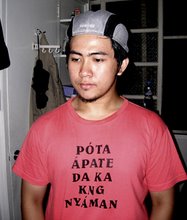
Alben meng manyaman, boy!

Showing posts with label Personalities. Show all posts

May 22, 2009

Kamaru photographs Palawan music video lead actors

Kalalangan Kamaru is currently in Palawan and will be back the 27th!

MODELS: JR Payuyo, Febbie Sabbaluca
LOCATION: Balsahan, Puerto Princesa City, Palawan

PHOTOGRAPHER: Diego Marx Dobles
POST-PROCESSING: Jason Paul Laxamana
LOCATION MANAGER: Jocelyn Fabello

Models will be the lead actors in the upcoming music video of "PLONING, ADIN KA REN" (Ploning, Where Are You) by Bulyaw Mariguen, a Cuyonon rock band. To be directed by yours truly.


May 19, 2009

Another [controversial] Filipino film at the Cannes Film Festival!

Brillante Mendoza: the “Love Him or Hate Him” Director
'Kinatay' stirs Cannes Film Festival

By Jason Paul Laxamana
Urban Kamaru
Central Luzon Daily


AFTER participating in the prestigious Cannes Film Festival last year with 'Serbis' -- a neorealist film about the Family Theater in Angeles City, San Fernando-born Brillante Ma. Mendoza is again vying for the main award, the Palm d'Or, in this year's festival with a violent film about the infamous “chop chop lady,” a grim character propagated by the news media in the late 90s. 'Kinatay' is also a co-production between Mendoza's Center Stage Productions and France' Swift Productions, the followup co-production after 'Serbis.'

The title of his latest work is 'Kinatay,' with English title 'The Execution of P.' Again written by Armando “Bing” Lao, 'Kinatay' is a story of a newly-married young police trainee who is need of more money to sustain his and his wife's education. To solve his problem, he goes with police officers to a clandestine mission of torturing a drug-addicted prostitute in Manila. Later on, the prostitute is mercilessly beaten, slaughtered, and chopped into bits, the parts wrapped in plastic, and thrown in various parts of Manila.

The movie, like in most Mendoza films, again stars Coco Martin. Mercedes Cabral, who played as the girl impregnated by Coco's character in 'Serbis,' is also back, along with Julio Diaz (also from 'Serbis'), and Lauren Novero (from 'Kaleldo'). The movie also stars Jhong Hilario, Maria Isabel Lopez, and John Regala.

Controversial again

As with last year's Philippine entry to the Cannes, 'Kinatay' has not failed to divide the audience and the film critics. There are those that brand the film as the worst entry in the festival, while others praise it for its unconventional style—no sensationalized scenes, slow rhythm, hand-held camera shots, absence of plot, lack of character development, and minimal lines. This is also partially thanks to the screenwriter, who is known to advocate for real-time scriptwriting.

This recurring style in Mendoza's films is what gets on the nerves of film critics who are not fans of the internationally acclaimed director. They describe 'Kinatay' as something that causes the audience alienation, resentment, and a feeling of having wasted money to see the film. Like in 'Serbis,' these critics also complain about the terrible traffic background sound which they describe as too noisy. Mendoza and Angeles City-residing producer Ferdie Lapuz both defend however that they are only trying to show the reality of noise pollution in the urban Philippines, which I couldn't agree more with.

The boldness of 'Kinatay,' on the other hand, makes it a probable choice in emerging victorious in the festival. Match, a German film distribution company, has picked up the controversial Filipino artwork for international distribution.


No more box office

Mendoza already knows that the films he loves to make aren't the films Filipinos want to see in theaters. That is why he just plans to hop from school to school to screen his films like 'Kinatay' to students, and then talk about the issue featured after the film. Such style of screening makes movie-watching more interactive, and makes education much more exciting than just being stuck in the classroom.

May 17, 2009

I AM ALWAYS A CONTEST LOSER, WAAAH! But...

For the past months, I have participated in a lot of contests both in the literary field and in the filmmaking field. Sadly, I have failed to become finalist in all of them, except one.

This is the great risk of writing and filmmaking -- you invest so much time, creativity, and even money (because you ship stuff to Manila, you buy DVD-Rs, print scripts and application forms, etc.) only to fail to become a finalist in the end.

Here are the contests I joined in:

Cinemalaya 2009 Short Film Category. My Asst. Director and I submitted two entries, Ing Bangkeru and Balangingi. We were torn between believing we can make it and conceding to the other filmmakers who have the money to produce technically good short films. But then in the end, we failed to penetrate the top 10.


Cinema One Originals 2009 Scriptwriting Contest. Unlike in the Cinemalaya Full-Length Category, where you have to submit only a synopsis of your film, in Cinema One, you have to submit a full-blown script -- which is what I did! I wrote a dramatic 80-page script about a male newbie in the Philippine literary scene and how the US financial crisis is indirectly affecting him. The title is Tagak at Tau (Egrets and People).

After my submission, I reviewed the finalists of the past year (finalists are given P1M to produce their scripts into films) and discovered that Cinema One is looking for out-of-the-box scripts, unlike Cinemalaya where their focus is realism and humanism. Cinema One welcomes experimental, science fiction, fantasy, and even horror. These are the genres I so love doing! Alas, I discovered that fact too late. And so, I lost again.

Carlos Palanca Memorial Awards for Literature. Alright, let me get this straight. I didn't join this year because I already conceded right even before I could start writing my entry to the short story category. I have joined for the past two years already -- first in the full-length Filipino stage play category, second in the English essay category -- and I lost, lost, lost! This year, I tried reading the entries of past winners, because the new Palanca website has made them available. The reading experience brings back memories of high school where you are required to read literary works which you barely understand, full of vocabulary words. I had no idea how my "dumbed down" works could fit in their roster. I decided not to join.

1st Philippine Digital Awards. This contest is very memorable to me because it's the first time I won an actual award/trophy. My entry was my Balangingi short film, which was classified under the ETC Short Film contest. The awarding was held at the World Trade Center in Manila, and it was the first time I delivered an acceptance speech on stage in front of the audience, composed of people I don't know and famous people like Gary V.


Ateneo Video Open 10. We joined in three categories: Short Narrative, Documentary, and Music Video. For short narrative, we submitted Ing Bangkeru and Balangingi. None of them made it to the top 5. For documentary, we submitted Sexmoan Adventures. It made it to the top 5! But when all the documentaries where screened at ADMU, Diego and I already conceded to Ang Pasko Ni Intoy. For music video, we submitted the music video of Oras by Mernuts and Alang Anggang Sugat by 5 Against The Wall. We can't figure out why none of those two became finalist, because honestly, the chosen finalists were blah. But hey, that's life. We got nothing in the end. At least our documentary was the funniest during the screening.

Most Outstanding Kapampangan Awards 2008. Lost in the Youth Category to a doctor who sortof like trained young people or something. Lost in the Culture and the Arts Category to a visual artist. Had I been entered in the Mass Media category, I would have also lost to internationally acclaimed filmmaker Brillante Mendoza. Oh well, another case for a 21-year old trying to compete in the contest of adults -- even in the Youth category.

Here are some more contests I joined, the results of which are still to be determined:

1st Flash Fiction Script Writing Contest by ACPI. ACPI stands for Animation Council of the Philippines, Inc. Yes! They (along with UNESCO) launched this contest that sought for scripts good for a 5-minute animation! Being a fan of anime and cartoons, I told myself I should join no matter what. I have been dreaming for the past few days of having a break in the young Pinoy animation (original content) industry by joining this contest and hoping to win! Not as an animator though; as a writer, because that's what the Pinoy animation industry needs.

I kinda like to think I have an advantage here. You see, scriptwriting for animation is a whole new discipline. It's not just any script. It's a very visual script. Try researching on it and you will understand. Are the literary giants to be feared here? Only if they are into animation and animation scriptwriting. Because no matter how good they are in writing, if they can't transform their works into an animations cript, it won't suffice. On the other side, we have the animators, or the animation students. They have long been exposed to this kind of skill, but the question now is--are they also good in creative writing?

Forgive me for sounding mayabang. I'd just like to think happy thoughts to save me from insanity in case I, again, lose in this contest. Anyway, I submitted Ang Mga Tagapangalaga Ng Bundok Arayat. I have often dreamed of making a comic book out of them, but since I can't draw much except for a couple of poses, I brushed off the idea. But I revived them for this contest.


The Farthest Shore: Fantasy From The Philippines. This is a literary contest seeking for Philippine secondary world-short stories (in English). What's a secondary world? Think Middle Earth of LOTR. Or the world in the Nick toon Avatar. Or the Mario World. Or, heck, even the Ibong Adarna world. In short, they were looking for stories written by Filipinos set in worlds that do not really exist, worlds only created by the writers. I wrote mine while I was having a vacation in the US. Title is The Destiny Twines of Makaru, set in a continent called Quemardican, in the country of Kasulipan. Fusion of local Kapampangan folklore and advanced psychic technology.

On the other hand, even though I often lose in contests, there is this thing I find weird. I may always be a contest loser, but how come I often get invited to screen my works? For instance, just last Friday, I was invited to deliver a talk on indie filmmaking at the Red Horze Muziklaban Rock Challenge, which now also embraces Indie Filmmaking, Tattooing, and Extreme Sports.

I had my own Indie Film booth at the kickoff party where I was able to screen all of my works to those interested to see. Shorts, docus, music videos, PSAs, and even the first episode of Kalam, I all screened! And then, when it was time for me to give a lecture, I also had two music videos shown (Alang Anggang Sugat and Kaplas) on the big screen on stage.

I'd like to think people were "amazed." After the event, I was even approached by this adult man named Bobby who so loved my work, he said he won't leave the party unless I give him a copy of my works.

Speaking of film, I also became the sole Pampanga participant in the Cinema Rehiyon Film Festival last February. Ing Bangkeru was screened at the CCP Dream Theater to represent Kapampangan indie cinema.

The music video of Oras by Mernuts which I directed has been accepted in the Tong Hits segment of MTV Pilipinas, making it the first ever Kapampangan music video to penetrate MTV. Two of my projects have been featured in Kapuso Mo, Jessica Soho separately. First was RocKapampangan, in their feature on the regional-language rock scene in the provinces. Second was Kalam, in their feature on regional-language TV dramas and films.

Ing Bangkeru has also served as front-act film to Brillante Mendoza's internationall acclaimed films (Manoro, Kaleldo, and Foster Child) when they were screened at the Holy Angel Auditorium. Around two thousand pairs of eyes were watching, and it sent shivers down my spine when they applauded after watching Ing Bangkeru (after watching the arrogant student get mentally owned by the lowly boatman).

In the field of literature, I was also chosen by UP Pampanga to represent Kapampangan literary writing (Junior Category) in the 1st Taboan Philippine International Writers Festival held at Quezon City.


In the field of cultural work, I have been invited to speak in various lectures. Language-related. Film-related. Culture-related. In both Pampanga and Quezon City. I've often been interviewed for the theses of different people. Even postgrad theses.

This is what I find weird.

I often lose in contests.

But I often get invited in these non-competition stuff.

I should be proud, I know, but I don't know... Maybe I yearn to win in a competition because it will give me a sense of hard-earned victory, defeating all others who joined... which is more valuable than just being "chosen".

Oh well, Regine Velasquez will always be my constant reminder. How she lost in more than 50 contests, and now, look at her! She's lovers with Ogie! And, oh yeah, she's a Songbird.

May 11, 2009

Nievera's 'Lupang Hinirang' - another exaggerated issue, proof of Pinoy shallowness

Conrado De Quiros wrote pretty well about the Martin Nievera issue. The brouhaha about the so-called "desecration" of the national anthem by proud nationalists is proof how insecure Filipinos are regarding their patriotism. They are superficial.

Theres The Rub
Footnote to a false note

By Conrado de Quiros
Philippine Daily Inquirer
First Posted 02:22:00 05/11/2009

I beg to disagree with some friends on this. “This” is the way Martin Nievera sang “Lupang Hinirang” in the Pacquiao-Hatton fight, which has brought him into a brawl with preservers of Filipino tradition.

The fight has so far been lopsided, with many authority figures, from congressmen to historians, knocking him down with a chorus of irate voices.

I myself have no problems with it. In fact I have a couple of reasons for liking it.

The first has to do with the barb that Nievera went the route of show biz by aping the American singers (mostly black) who make the “Star-Spangled Banner” sound like Motown each time an American boxer takes to the ring. Which, as the nastier remarks go, is probably because Nievera is an American at heart and on paper. I leave others to argue where Nievera’s loyalties lie, though given all the open and closet “statehooders” here—Filipinos who long for the country to become a state of the United States—not least among the congressmen, I wouldn’t advise pressing this point too loudly.

But even if Nievera went show biz, what of it? Boxing is pretty much show biz, of the loud and glittery type. And though Nievera did not sing “Lupang Hinirang” traditionally, he did not disrespect it either, to use a word much favored by African-Americans.

The reason Americans do not mind their National Anthem sung like gospel (or its modern reincarnations; I wouldn’t be surprised if it becomes hip-hop one day) is that they are secure in their patriotism. They are secure in their sense of country. They are secure in their loyalty to flag and country. Enough to withstand Jimi Hendrix’s “sacrilegious” interpretation of the “Star-Spangled Banner,” which he did in Woodstock, his awesome guitar blaring out the din of discord in protest against the Vietnam War. That version has since been elevated to iconic status by baby boomers.

Our prissiness with orthodoxy is in fact a symptom of an affliction as worrisome as swine flu. We like revering tradition because we prefer form over content, because we like showing our love of country in ritual rather than in practice. We like to build busts and monuments to the heroes without liking to follow their ideals and actions, which is really the best tribute to them. The religious equivalent of this is that we like to hear Mass and receive the sacraments without liking to live lives that are not given to lying, cheating, stealing and murdering.

It’s like that line in “Lupang Hinirang:” “Ang mamatay nang dahil say iyo” (“to die for you”). I’ve always said that was a perfect, if ironic, commentary on us. We’ve never had problems dying for country, we’ve always had problems living for it. I’ve always suggested—utter sacrilege!—changing it to, “Ang mabuhay ng dahil sa iyo” (“to live for you”).

My second point is: Why on earth should we regard tradition as intractable or unchangeable?

Even the Rock, or the Church, changes. I still remember the time when the Mass, which used to unfold with Latin incantations, gave way to idiomatic English. Or indeed, horror of horrors, when the Gregorian chant gave way to the “Guitar Mass.” Once things that threatened to make the faithful faithless, plain language and (middle-of-the- road) pop (if not rock) are rock-solid orthodoxy in Masses now.

In the case of historical tradition, I should think changes should not just be acceptable to us, they should be welcome to us. I say this because our lack of sense of history—truly notorious in that we can’t even remember the recent past—owes in great part to our tendency to embalm history. To treat it as something dead and gone and remembered only on the historical equivalents of All Saints’ Day. One natural consequence of this is to turn history into sacred text and the heroes into untouchable objects of worship.

I still remember how we used to look at Jose Rizal, Andres Bonifacio, Apolinario Mabini and the other heroes that way, courtesy of high school and college. Something the new wave of historians led by Renato Constantino corrected, turning them into ordinary folk who did extraordinary things in their time and place. No less, or more, than the activists did in their time and place. The process of demystification, or “humanization,” would culminate in historians like Ambeth Ocampo who would make Rizal et al. as contemporary as, well, Nievera’s rendition of the National Anthem.

Which makes me wonder why Ambeth in particular should disapprove of that rendition. I recall that when he was pilloried by purists for “watering down” history with his “pop” version of it, I wrote a column saying that far from detracting from the worth of history, he added to it. Specifically by making the past present, by making the dead living, by making history not history in the idiomatic sense of “we’re outta here” but history in the sense of current events. The power of history lies precisely in its being living history, or a “continuing past,” as Constantino put it. One would imagine that a continuing past uses the idioms or idiosyncrasies of the flowing present. That’s what makes the past worth remembering. That’s what makes the past worth living.

It’s not just that I don’t think Nievera has done any harm by his version, it is that I think he has done much good with it. Anything that hooks the youth in particular of this amnesiac country to their past, even if it feels like a right hook to those who take that past reverentially, is fine by me. History has been known to rock, history has been known to roll. Sometimes, history has even been known to OPM.

In any case, I have a lot of friends who’ve always thought the National Anthem wasn’t “Lupang Hinirang” but Juan de la Cruz’s “Ang Himig Natin.”

May 10, 2009

New Kapampangan rock music video - Happy Mother's Day!

Happy Mothers' Day (Masayang Kayaldawan da ring Ima) to all of our dear mothers! Before I left for the US, we were able to shoot the band scenes of Mental Floss' music video for their RocKapampangan song "Ing Lugud Ning Indu" (Love of a Mother). We really intended to finish the video by Mothers' Day, but sadly, we didn't.

So I'll just say: Abangan! Here are some screen captures from the video. If you notice, the vocalist is pregnant, too! She's soon to become a mother! Congrats, Nicole!


Meanwhile, here is an old video of Mental Floss performing 'Ing Lugud Ning Indu.' Don't you think it's a nice Kapampangan song?

May 7, 2009

The Pacquiao Victory: Pop Icons and National Pride

By Jason Paul Laxamana
Urban Kamaru
Central Luzon Daily

In a certain forum on the Internet, members are arguing on whether Manny Pacquiao's victory against Hampton should be given that much of a deal, to the point of labeling a boxing champ a national treasure. The thing is, in the Philippines, it's no longer a question of whether it should given that much of a deal because obviously, it already has for past years.

Named the “National Fist” of the country, everytime Pacquiao's match abroad arises, the Philippines—from the urban to the rural—is expected to lay still like it's celebrating a holiday. All eyes, regardless if they belong to Muslims, Christians, the poor, or the elite, are on his match, and the unofficial celebration rivals even Ramadan or Good Friday. Crime rate can go as far as zero percent and comes the time Pacquiao knocks out his opponent, we all jump together in triumph like winning a war against an invading country.

I am not here to judge whether this is bad or good. In the country of Barbados, RnB sensation Rihanna is very admired, in that the government decided to appoint a Rihanna Day in its calendar. It's a national holiday! In South Korea, international pop star BoA has been given an award by their President because her musical prominence in both South Korea and Japan is said to have contributed to the easing of the tension between the two countries (South Korea was invaded by Japan in the past).

However, it's slightly different in the Philippines because Pacquiao's victory, whenever it arises, seems to be the most important moment for the Filipinos. Pride rises from the heart to the head, and it makes the Filipinos think, “Damn, I so love being a Filipino.” In fact, I don't think our national hero Jose Rizal has ever causes current Filipinos to feel that way.

Manic with Pacquiao

The reason Filipinos are manic with what some intellectuals call “shallow” bases of pride—such as Charice Pempengco making waves in the US, Manny Pacquiao's winning in matches, or even Apl De Ap's inclusion in the Black Eyed Peas, is because we are a quasi-nation state.

A quasi nation-state is a community (like the Philippines) where the state was formed first before the nation. We know our Philippine history. The Spaniards forced us together into a country, not caring about our cultural diversity, linguistic dissimilarities, and regional competitions. Mindanao, they say, has never been conquered by the Spaniards; that is why they are asserting their “right” to secede from the Republic.

There were several ethnic groups that, in the past, formed several small “nations,” with their own specific languages, goals, songs, customs, etc. These small nations were forced together against their will. And so, trouble begins.

Now that the physical invaders are gone, and now that the Philippines is left to the hands of the natives, we are struggling to make ourselves a nation despite the long existence of the state. Difference is, the state was formerly in the hands of foreigners.

This quest for nationhood is the reason we have the National Bird, National Song, National Dance, National Language, etc. even though for example, the Northern Luzon people do not dance the tinikling, or even though majority of Visayas and Mindanao people used to not speak Tagalog at all.

Each ethnic group has its own precolonial gems of pride—local heroes, folklore, dances, literature, and cuisine—but since we are now one, these are usually dissolved. Lucky are those that get absorbed into the national scene, like the Barong Tagalog and the Sinawali style of arnis, to become Filipino property instead of, for example, Cebuano, Pampango, or Igorot properties.

Vacant positions

Since the Filipino nation is a new thing, we are desperate in finding other sources of Pinoy pride. Kapampangan pride, Ilonggo pride, Waray pride—these are all to be shut off because regionalism is said to be one of the major hindrances to national unity. “We need Filipino pride!” nationalists wail. The government and the educational institution solve this by trying to produce competent contemporary artists in the realm of high art: painting, ballet, classical music, cinema, etc. But honestly, do the masses look up to the high arts? Does even the middle class look up to the high arts? I think they look up more to pop icons.

So when popular cases like Pacquiao, Pempengco, Apl De Ap, or even the Filipino chefs in the White House, reach the consciousness of the masses through local mass media, they rejoice and claim they are proud to be Pinoy, because without them, we feel we are losers in the global arena, with all the bad news and reputations we have—corruption, unlawfulness, tax evasions, scandals, and poor waste management. Other countries like China, Korea, or the US don't care if any of their citizens or expatriates make it big in the Philippines because they appear to be not insecure.

We are insecure!

This artificial, fragile pride of ours is also the reason that whenever someone blasts the Filipinos, we whine like crybabies. Remember the so-called ethnic slur from Desperate Housewives? The 'Family Guy' cartoon and the 'Mr. and Mrs. Smith' movie also had made fun of Filipinos in one of their lines, but they're lucky Filipinos didn't pick them up. And let's not forget the Hong Kong-based columnist.

That's how fragile our national pride is. Atuan me mung bagya, kumiak ne. I am quite sure there are plenty more Filipinos who have wrote negatively about Americans, Koreans, or other nationalities, but I am also quite sure we never heard anything from them—nothing compared to how far we want to go to express our national disappointments. They never made petitions or rallies or whatever, asking for public apologies and stuff. American shows make fun of Koreans, Chinese, Frenchmen, Canadians, and Mexicans more but they don't act like crybabies like Filipinos.

Omitting the Quasi

The transition from being a quasi nation state to being a genuine state is a hard one. It's going against our nature because nationalizing ourselves means extinguishing some items that make up our diversity, as the less powerful ethnic groups are systematically forced to succumb to national policies (that are supposed to be democratic). Remember how Ramadan used to be NOT a holiday for non-Muslims in the Philippines, yet Muslims take a holiday during Christmas because government said so?

This is not unique to Filipinos though. China is undergoing the same process, trying to eliminate its diversity with its “Zonghua Minzhu” concept. “One China,” the People's Republic says. Rebels like the Tibetans are pacified and Taiwan is endlessly being wooed into unifying with China. Only Mandarin is the language in China and the others are systematically reduced to dialects (like in the Philippines). What makes them successful in their nationalizing actions is that they have an authoritarian government which has access to lots of resources.

The Filipino government cannot do that because it is poor and democracy is highly fought for.

May 3, 2009

Violin + Hip Hop Dance = Henry Lau

There's this 13-member boy group (world's largest number of members for a boy group) managed by SM Entertainment, a Korean record company.

This boy group is called Super Junior and they have so-called subgroups, such as Super Junior M (Mandarin) for the Mandarin-speaking market, Super Junior Happy, Super Junior T (Trot) which capitalizes on the so-called trot music or pongjak of Korea, Super Junior Happy which specializes in happy/uplifting pop songs, and Super Junior KRY for the more mature fanbase of the boy group.

A Chinese Canadian boy named Henry Lau, although not an official member of Super Junior, was admitted as a guest member for the subgroup Super Junior M.

I find him very cool because he plays the violin while dancing hip hop! Ain't he enviable?! I sure wish I were him. Or something.


He guested in one of Super Junior's tracks titled Don't Don, where he also appeared on the video. You have to wait until the middle part of the video to see Lau in action.


Cooooooolness! And I learned he plays the piano, too. Now I'll just have to wait for him to come up with ways on combining hip hop dancing and hitting the keys.

April 21, 2009

Kalalangan Kamaru to participate in Cuyonon music video production

(posting this from Joey Fabello's journal)

The Ploning Adin Ka Ren Music Video Auditions

PURPOSE

Bulyaw Mariguen’s Songs are rock and acoustic songs in the Cuyonon language having contemporary society as the setting of each story within the songs. The stories in their songs represent a reality seen through the eyes of urban Cuyonons who are exposed to both traditional Cuyonon practices and rituals and to the effects of a globalized world. Their songs are also the first Cuyonon rock songs broadcasted, promoted and made available in Palawan through one album, thereby making Bulyaw Mariguen innovators of Cuyonon music.

Bulyaw Mariguen’s songs are the first of their kind. Promoting them to the Filipino community thus shows the Filipino community of the existence of the Cuyonons and their drive to be heard in a country monopolized by creative outputs in Tagalog.

GOALS

As a means to have Bulyaw Mariguen's Cuyonon rock and acoustic songs heard by and promoted to a greater number of other Filipino cultural groups (through music video channels broadcasted nationwide), Cuyonons (since a lot of Cuyonons has migrated to different parts of the country already) and Palawenos (since most Palawenos patronize national television), a music video of one of Bulyaw Mariguen's Songs, PLONING ADIN KA REN, will be shot in Puerto Princesa City, Palawan this coming May 2009.

PARTNERSHIPS

Through the help of the Palawan Broadcasting Corporation (DYPR TV PATROL, DYPR PALAWAN RADYO and IFM 99.9), Kalalangan Kamaru, the Iwahig Prison and Penal Farm, cuyopress.com and different individuals (the list of which is ever-increasing as we come closer to the shooting dates of the music video), matinlo productions is able to produce this music video (Ploning Adin Ka Ren).

CASTING CALL/AUDITIONS

Auditions for the lead actor and the lead actress of the music video have already started last April 18 and 19, 2009 at the DYPR Dance Studio (Mabini cor Valencia Street, Puerto Princesa City). Second Batch of auditions starts tomorrow (April 20, 2009) 1 to 3 pm at DYPR.

Should you be interested to contribute your skills for the said project, we are also looking for other individuals to form part of the cast of the music video. Please check the characters needed in the succeeding paragraphs.

THE CONCEPT

The Ploning Adin Ka Ren Music Video is not the usual music video that you see in music television channels. For one, the music video will have English or Tagalog (depending on the market) subtitles to make the songs understandable to the viewers of the music video. At the same time, the concept behind the music video is highly symbolic of what is happening to the Cuyonon culture and the struggle of the music of Bulyaw Mariguen to be accepted by the public who seem to condemn than support such innovations in music.

THE CAST

LEAD:

The Young Modern Ploning
Young Looking (around 20s look)
Good at acting
Experience in TV production (not required)
As long as she is easy to direct

LEAD:

Ploning’s Lover
Young Looking (around 20s look)
Good at acting
Experience in TV production (not required)
As long as he is easy to direct
PLONING’S MOTHER
CORPORATE PEOPLE
MAN IN SUIT OR IN POLO
WOMAN IN SUIT
TEENAGE GIRL AND BOY (ANIME LOOK)
STUDENTS
1 COLLEGE STUDENT (BOY)
1 COLLEGE STUDENT (GIRL)
1 HIGH SCHOOL STUDENT (BOY)
1 HIGH SCHOOL STUDENT (GIRL)
1 TEACHER- WOMAN
RELIGIOUS FIGURE
NUN
BABAYLAN
MUSLIM WOMAN
CLOWN (can perform simple tricks)
MUSICIANS
FOLK GUITARIST
POP GUITARIST
INDIGENOUS PEOPLE
SOMEONE WEARING AN ALAKAYO MASK COVERED IN BLUE DYE (ANYEL)
TAO’T BATO
TAGBANUA (MOTHER AND CHILD)
TAUSUG- FEMALE

NOTES:

It must be noted that the production team took gender issues into consideration. See Religious figure and the attempt to represent girls and boys in most groups. It must also be noted that the indigenous groups chosen to be part of the INDIGENOUS PEOPLE cast are those who can be found in Palawan.

LOCATION


The location of the music video is at Balsahan managed by the Iwahig Prison and Penal Farm. (Thank you for letting us use the location for free...!)

THE PRODUCTION TEAM

The production team behind the music video is composed of people from different production teams such as matinlo productions and KALALANGAN KAMARU and different individuals who are interested to contribute their skills for the production of the music video.

Matinlo productions is owned by Joey Fabello and in this production absorbed the responsibilities of a Producer and a Production Manager. The director and the assistant director of the music video came from Kalalangan Kamaru.

The director of this music video is a multi-awarded Kapampangan director and cultural advocate. He bagged the First Philippine Digital Award in short film category from the Entertainment Channel (ETC) this year, is the director of the First Ever Kapampangan Telenovela in the Philippines (Kalam) and the director of the music video of Mernuts entitled Oras, seen at MTV Pilipinas. He was also the one who spearheaded the Rockapampangan Project together with Holy Angel University.

A detailed list of the cast and the production team will be made available in the succeeding pages. If you are reading this entry from a different site, please visit our official blog site at http://www.bulyawmariguen.blogspot.com/. Also, if you know someone who might be interested to be a part of the cast and or the production team, please contact Joey Fabello at 09276275554 or Mares Krishnaa Bajar at 09085421141 or please forward this entry to them.

MATAMANG SALAMAT, WE NEED YOUR SUPPORT! SEE YOU AT THE AUDITIONS!

April 18, 2009

Sandara Park: Jologs in the Phils, Kinda Cool in Korea

So I was randomly watching East Asian music videos when I encountered a song called "Lollipop" by a popular Korean boy group called Big Bang (songs of which I have in my MP3 player currently), featuring a girl group called 2NE1.


I was watching the video, it was kinda bubblegum-pop/hiphop cool. But one of the members of 2NE1 was somewhat familiar in my brain. Then, in the middle of the music video, I had this thought:

She friggin' looks like Sandara Park (of Star Circle Quest fame, partnered with Hero Angeles and Joseph Bitangcol)!

So I researched on the girl group, and boom! It's Sandara "Dara" Park!

To like Sandara Park as a singer/dancer ('Sumusunod') in the Philippines is kinda jologs or uncool, but look at her under YG Entertainment (Korean label)! She's kinda cool.

Just goes to show that a lot of Philippine producers are baloney. I am nationalistic and all, and have always believed that Pinoy artists have what it takes, but our producers are just too mediocre to send a Philippine wave abroad. Sorry.

April 6, 2009

Pinoy X-Men and Street Fighter characters, anyone?

By Jason Paul Laxamana
Urban Kamaru
Central Luzon Daily

There have actually been a lot of popular fiction titles—in TV, movies, video, and PC games—that offer racially diverse worlds. In these titles, the main characters are not just White Americans, albeit the setting could most of the time be in the United States.

Take for example the diverse universe of X-Men, where characters are not just from different countries—they are also from different times, from different dimensions, from different planets, galaxies, and even different universes. Let’s focus on planet Earth though. We have popular delegates from Canada, the most popular being Wolverine. Russia is highlighted by Colossus and the Soviet’s prime weapon Omega Red. Storm is Egypt’s proud mutant. We also have Gambit from France, Nightcrawler from Germany, the Jewish Magneto, and many more.


Then we have Street Fighter, which you probably had your first glimpse of with the movie ‘The Legend of Chun-Li.’ I, on the other hand, have known Street Fighter ever since I played Street Fighter 2 back in my Elementary days.

Being a world geek (in Elementary, I was able to literally memorize the capitals of all the countries in the world in whatever continent; Antananarivo, Ulaanbaatar, and Tegucigalpa were my favorite place names), I found the video game Street Fighter amusing, with each playable character representing a certain country, and at times, representing the martial arts and traditional fashion of that country. You can even choose a country to serve as your game’s location.

Ryu and Honda represented Japan; Ken, Balrog, and Guile represented USA. Dhalsim, a personal favorite, represented India while his skills revolve around the discipline of Yoga; Saggath, Adon, and Bison (albeit biologically Irish) of Thailand; Blanka of Brazil; Chun Li of China; Fei Long of Hong Kong; Dee Jay of Jamaica; Zangief of Russia, with Sambo-inspired brute skills, a popular sport in Moscow; Cammy of England; T. Hawk of Mexico; and Vega of Spain, among others.

Kiddie cartoons also have their share of diverse worlds, such as ‘Codename: Kids Next Door.’ Numbah 1, the leader, is a British boy. Numbah 2 is a blonde Australian kid. Numbah 3 is a happy and seemingly slow-minded girl from Japan. Numbah 4 is a techie stout kid from the United States. Last but not the least is Numbah 5, a black French girl. Together, they are known as the Kids Next Door.


Filipino, wer k?!

Having been concerned with the status of Kapampangan in the national setting, and of the Philippines in the global setting, I once included in a Kapampangan short story a boy who was wondering why there was no Filipino character in Street Fighter 2. Then, he began imagining how the Filipino fighter would look like and what his skills would be if ever Capcom decided to included Philippines in its roster of fighters and locations.

Now that you have read the first part of my article, it would be easy for you to tell that I am speaking through that kid, albeit I never thought of that as a kid.

But I still wonder: why is the Philippines often neglected in these fictional worlds of diversity. Is it our being a poor country? Is it our unpopular local culture, unlike those of Japan, Egypt, and China? Is it our cultural diversity, rendering other countries unable to figure out a single icon—or even a single audio-visual stereotype—that would represent a Filipino character?

Minute Moments of Glory

Filipinos have taken small parts in the world of fiction abroad.

Take for example the demon-possessed Filipina in the opening sequence of the religious fantasy Constantine, starring Keanu Reeves, where she even spoke a Tagalog line ("Papatayin natin siya"), albeit unnatural.

The original Starship Troopers storyline from the book had Juan Rico, the main protagonist, as a Filipino, accompanied by a multiracial training group.

Dante’s Peak spoke of the eruption of Mt. Pinatubo in its lines.

Ashton Kutcher’s MTV Punk’d once used as accomplice a red carpet correspondent who spoke Tagalog to celebrities passing by.

A Tagalog-speaking ventriloquist can also be found in the Hollywood movie ‘Big Fish,’ starring Ewan McGregor, when his character was parachuting onto the Korean stage.

Sinawali, a fighting style credited to the Kapampangan warriors of Macabebe, is included in the Kali Silat martial arts DVD available in the United States.

We have also expressed our protest in several so-called "racial slurs," from the ‘Desperate Housewives’ to BBC’s ‘Harry and Paul’ show. The latest of course would be that "nation of servants" label from a Hong Kong columnist.

Filipinos also giggle in mirth upon seeing the name of their country included in global listings and popular world cultural products, such as Philippine English being recognized as a significant dialect of English, the Philippines being one of the most SMS-crazy country, our country being mentioned in one of Britney Spears’ songs ("Piece of Me"), and a lot more.

We are not alone

Of course, we are not the only country neglected in diversity-driven titles. We’ve never seen characters from Trinidad & Tobago, Bosnia & Herzegovinia, Vanuatu, Lesotho, Belarus, Luxembourg, Seychelles, Djibouti, Sao Tome & Principe, Malawi, and Azerbaijan except probably in Miss Universe pageants.

Despite having history with contemporary and former world superpowers such as USA, Spain, and Japan, we still don’t appear in their imaginations, in the shows and games they produce. And whenever we do, it’s either a pitiful bit or a derogatory portrayal.

We don’t even have to think global to notice our ethereal identity. Whenever the world speaks of Asia, or Asian culture, they are most probably referring to the Chinese, Japanese, and Korean, and to a great extent as well, the South Asians (Indians). Thailand, Indonesia, and Malaysia will come to mind on the other hand when we begin to talk about South East Asia.

A pity, isn’t it? Don’t get me wrong though. I wrote this article because I believe we have to know our place, our status, in the world before we can pinpoint how to work about things. Because for all we know, a lot of Filipinos are already complacent, living in the delusion that the Philippines is a very popular country in the world, with all the Manny Pacquiao victories, American Idol participations, foreign film festival engagements, and the Charice Pempengco citations. "Feeling sikat," as we often say.

It’s an effective source of pride for a lot of Filipinos whose world knowledge is limited to what free television can share; I just hope we can make Pinoy pride injected into the global consciousness, not just local.

Please email your reactions to sisig_man@yahoo.com.ph

March 17, 2009

Kapampangan art is not acclaimed in Pampanga

‘Balangingi’ is ETC Best Short Film Awardee
Why are Kapampangan artworks awarded in other places but not in the province?
By Jason Paul Laxamana
Urban Kamaru
Central Luzon Daily

World Trade Center, Metro Manila—our Kapampangan short film ‘Balangingi’ (Nosebleed) wins the ETC Award for Best Short Film at the First Philippine Digital (Phil Digi) Music and Short Film Awards last March 12. Competing in a certainly Tagalog-dominated category, ‘Balangingi,’ in spite of being the only regional language entry, still impressed the Board of Judges from Entertainment Central (ETC), causing them to declare it the winner.

‘Balangingi’ tells the story of Xoo, who seems to be a standard teenager who lives boringly like everyone else, but unknown to people in his surroundings is what happens in his head—philosophizing about things average people would deem mundane, down to the minutest detail. One day, he is forced to attend a blind date. To avoid turning off his date, he struggles to suppress his intellectual side. The short film gives a peek to that minority in Philippine society who are unlikely to survive socially by being themselves—the Filipino intellectuals. Thus, the negative connotation of the local word “pilosopo” when it’s supposed to mean a lover of wisdom (philosopher).

According to the official website of the Phil Digi Awards: “There have been a lot of songs composed that are worth listening to. Quality short films are created even with low budget but are amazingly filled with art, ideas and moral values. Unfortunately, because of budget constraints, tough competition in getting radio airplays and film screens, and lack of knowledge, these great songs and films are being shelved. This is why iSYS Business Solutions and Blue Fish Asia came up with first Philippine Digital Music and Short Film Festival.”
Kapampangan Kompetes!

As usual, being a cultural worker seeking to empower the Kapampangan identity, I participated in the contest to “advertise” what Kapampangan can offer.

Note: I said what Kapampangan can offer, not what Kapampangans can offer. There’s a difference. It’s easy to show the world that Kapampangans (by blood) can be excellent. But oftentimes, these Kapampangans drop their being a Kapampangan—either consciously or not—to command the spotlight unto them. This, in my opinion, doesn’t empower the Kapampangan identity much. Whenever this happens, I just shake my head and whisper, “We’ve lost another one.”

In the venue of the Phil Digi Awards, there were huge tarpaulins where participants and guests can write anything—a freedom wall. Amidst the Pinoy pride slogans, individual promotions, and indie artist empowerment statements, we decided to write a message: “Kapampangan Ku, Pagmaragul Ku.”

Hours passed, and messages became more cramped in the tarpaulins. Checking out the “Kapampangan Ku, Pagmaragul Ku” again, we were surprised to see a reply written by a certain Larry, saying, “Kapampangan ku mu rin!”

Fast forward. ‘Balangingi’ was declared winner in the ETC category. I went up the stage to nervously deliver the first acceptance speech of my life—which started with “Mayap a bengi pu” and ended with a message on promoting Philippine cultural diversity—before an audience of both indie and mainstream artists, while being covered by the media.

And then we left, but not before checking out again the tarpaulin. Another reply, written by someone else, was suddenly added: “Aliwa la talaga ring Kapampangan!”

Perhaps we need more of these, as I call them, contemporary sources of Kapampangan pride—those that genuinely bring elements of Kapampangan identity to a more prestigious ground. For if we keep on drawing pride from Kapampangans who are successful but don’t carry with them elements of our identity (such as language, heritage, etc.), then we’re perpetuating the idea that the path to being successful is to drop our Kapampangan identity, when it is very possible to stick with Kapampangan (or make it the foundation of our works) and still get national or even global recognition.

Ligligan Kilual

The very reason I join film, music, and other competitions outside Pampanga is because Pampanga doesn’t have these. Hence, if I depended on what the province has, then I would have no means of increasing the symbolic value of my works, in spite of some of them probably being valuable to a certain degree.

There are no renowned music awards in Pampanga that would honor the best of the locally produced original songs annually; only specialized areas like those Battle of the Bands and so-so solo and choral singing contests. There are no film festivals. There are no province-wide literary contests except for municipality-level poetry tilts that produce Poet Laureates irregularly.

In result, a lot of Kapampangan artists who wish to prove something, feast their eyes on Manila and other countries, where it is actually easier to get formal acclamation than in their own homeland, just for the sole reason that the province doesn’t care much about the artistic capabilities of its residents, as seen in the scarcity of serious award-giving bodies.

An unrelenting source of funds, a board of credible judges, sincere support from the government, and media hype—these are the key ingredients in carrying out annual contests which are supposed to be looked forward to by the community, and looked up to by the people. Emerging as a first-time victor in these contests should make one feel as if he has undergone a birth of fire. He should feel several notches prouder, being aligned with the past winners who are supposed to be icons of excellence, as well.

But we have none. Probably the highest award from the province that can be bestowed to a writer, musician, visual artist, photographer, filmmaker, or actor would be the Most Outstanding Kapampangan Award for Culture and the Arts. So all your life, you have to struggle with your craft, reap awards from anywhere but your homeland, and when you have enough nice foreign awards up your sleeve, that’s when the province honors you.

But the province itself doesn’t make impressive actions in encouraging the best in the various areas of art.

Sindi, Patda

Contests are often held because they serve significant purposes—to encourage the creation of excellent artworks amidst art being a financially unrewarding career path in the country (especially in the province), and to invite the participation of the community in a certain field of art.

In a seemingly robotic world where almost everyone is reduced to a mechanical being tasked to perform a dehumanizing routine to survive, sustainable development in the arts will remind people of their humanistic side. I believe that the acknowledgment and exploration of our humanistic side prevent us from being insane from routines; and permit us to choose wisely and embrace elegant world views that will guide us sensibly in our decisions in life.

I know for a fact though that fields of art like music and sculpture thrive both in rural and urban Pampanga, but as Phil Digi Awards mentioned, these are usually shelved. They are made, but not distributed. Not all of them are excellent, but I’m sure a couple are, and they deserve to be known.

Now I ask: What efforts does the province make to seek for these artworks that deserve attention? What steps does the province take to collect these pieces of consciousness, which in the far future will remind the people how the art scene—which reflects culture, too—in Pampanga used to be?

Pampanga is becoming more and more like a parent who doesn’t care much about the promising talent of his/her child. What will the child do? He will either suppress his talent out of discouragement and choose the “more practical ways of life” (read: be like everyone else, go where the flow is, don’t innovate, don’t lead, just follow); or he will seek for other people who will greatly acknowledge his skill—and stick with those people in spite of not having the same blood relation.

Or is Pampanga that poor for it to not think about these things? I thought we were boasting of economic progress for the past years. If indeed we are poor, doesn’t the Pampanga government bother to take advantage of national grants, like for example, those of the National Commission on Culture and the Arts, to organize decent tilts?

If this is how lifeless the Kapampangan region will be in the realm of arts, then let me have my second thoughts on federalism and having a separate state for Kapampangans.

February 22, 2009

The Curious Case of Kapampangan Cinema

A personal account of a Cinema Rehiyon participant
By Jason Paul Laxamana
Urban Kamaru
Central Luzon Daily

Cinema Rehiyon was held last week at the Cultural Center of the Philippines (CCP). It is the NCCA’s (National Commission for Culture and the Arts) Cinema Committee’s event for the then-called National Arts Month, now Philippine International Arts Festival (PIAF).

Cinema Rehiyon is the first ever film festival in Manila that puts the spotlight on independent films from the regions. Since the concept of Philippine Cinema has for long been Manila-centric, it is now time to decentralize it and take note of the more politically correct perception of Philippine Cinema—a collection of films from every corner of the archipelago, may they be indie or mainstream.


No Kapampangan participation

I make this personal joke—unfunny to some, probably—about Kapampangans naturally lacking the letter H in their speech. Despite this, it is ironic that they seem to be more involved with the Hearts’ Month during February instead of the Arts Month.

When the press release for the lineup of events for the PIAF was released, along with the focused provinces and cities of Cinema Rehiyon, I felt very bad because Kapampangan had zero participation.

“This is a showcase of nascent cinema from the regions. From the highlands in and around Baguio to the heart of Bicolandia that is Naga City; across the thriving Visayas cities of Cebu, Bacolod and Iloilo; and through Mindanao between Cagayan de Oro and Davao, a new generation of artists is telling stories of their own cultures and people in cinematic form.”

Being a Kapampangan indie filmmaker, I at once called the NCCA Cinema Committee and inquired whether the Kapampangan region can be represented by one of our short films—Ing Bangkeru (The Boatman).

No solid block

After more than a month of deliberation, they decided to include our film in the lineup, albeit categorized under the ambiguous “Short Films from Various Parts of Luzon” block. Our film shared space with a Laguna short film, a Batangas short film, and a Nueva Ecija short film—all Tagalog entries.

Enviable are the regions/provinces/cities that enjoyed a more definite block: Cebu short films, Bacolod short films, Cagayan De Oro short films, Central and Western Mindanao short films, Davao short films, Bicol short films, Baguio short films, and Iloilo full-length films.

Being the only Kapampangan during the festival, I actually felt lonely, seeing Cebuanos, Dabawenyos, Bicolanos, etc. come in numbers with lots of films to offer for the festival, speaking with one another in their respective languages.

It’s really tragic because Kapampangans have always played their part in national history (two sunrays in the Philippine flag are Kapampangan provinces), even in the field of arts. The CCP, where the festival was held, even has two areas named after two Kapampangan artists: Vicente Manansala and Aurelio Tolentino. Yet during Cinema Rehiyon—a historical event in the history of Philippine Cinema, I must say—we looked like a dying cultural minority, despite being one of the major ethnolinguistic groups of the country, and being one of the most progressive provinces in the country to date.

Alive after all...

Come to think of it though, an exclusive Kapampangan block could have been made. Aside from our “Ing Bangkeru” and our numerous other works (documentaries and music videos), there’s “Pupul” (Harvest) by Nicolette Henson, which bagged best narrative in her production class under Pam Miras at St. Scholastica’s College. It also made it to the Top 10 of the Short Narrative category of the Ateneo Video Open 10.

Then of course we have Mark Dela Cruz’ “Misteryo Ng Hapis” (Sorrowful Mystery), a full Kapampangan short film which enjoys several titles under its sleeve, including Best Picture in a recent year’s PBO Digitales, Best Thesis during its time at the UP Film Institute, Finalist in Cinemalaya 2007’s short film category, and Finalist in a recent Ateneo Video Open. It also competed in Cinemanila years ago. Following the trend is UP Film student Jacqueline Nakpil’s “Ke Lual Ning Kulambu” (Outside the Mosquito Net), her production thesis in 2007

Kapampangan full-length films are also existent. We have the internationally award-winning Kapampangan films of Brillante Mendoza like “Masahista” (The Masseur; City of San Fernando), “Kaleldo” (Summer Heat; Guagua), “Manoro” (The Aeta Teacher; Sapang Bato, Angeles City), and “Serbis” (Service; Angeles City). Although Mendoza’s Center Stage Productions is Manila-based, most of his actors and staff are his kabalen when he does Pampanga-based films. I should know; I have worked for him.

The Cinemalaya Best Picture of 2008 “Jay” (Bacolor), directed by Francis Xavier Pasion, can also be included. Even though the Manilenyos’ participation in the creation of the film was inevitable, most, if not all, actors actually hail from the province, as the auditions were held at DHVCAT in Bacolor. Even the lead actors, Baron Geisler (Angeles City) and Coco Martin (San Fernando), are Kapampangans.

But here’s the problem...

Despite the presence of these Kapampangan films, which are just as good as—or even better than—the other blocks I’ve seen during my three-day viewing of Cinema Rehiyon blocks, why have the organizers failed to detect us?

I know why. It’s because these Kapampangan films are not organized, unlike in Davao, Cebu, Bacolod, Iloilo, and other areas. Kapampangan productions sprout here and there, in various competitions, in various places, from Manila to Pampanga. They have all been individual efforts by various filmmakers who represent only themselves or their schools, not their homeland; filmmakers who are not yet well organized into a Kapampangan film community.

Most of the time, the people behind these Kapampangan films don’t even know the presence of other Kapampangan films, because each filmmaker is busy with his own career, flying solo either to Manila or abroad to propagate his/her own film, without thinking “I’m representing Kapampangan cinema.”

Is selfishness the root of this? I actually don’t think so.

The root

With conviction, I believe that the root of this is the deterioration of our people’s sense of being members of the Kapampangan community. The Kapampangans’ imagination of themselves as an equally distinct group like the Warays, Ilocanos, and Cebuanos is fading away, with Kapampangans, especially the talented ones, preferring to join the so-called Filipino community, which is actually just the Manila community.

While Kapampangan Cinema is a thing yet to be born, Kapampangans are actually not newbies in the industry. Manila has always employed the skills of Kapampangans—whose homeland is very near—in developing their film industry (and other industries as well): from Rogelio Dela Rosa to Gracita Dominguez; from Gregorio Fernandez (directed “Asahar at Kabaong,” “Senorita,” and “Higit Sa Lahat,” which won for him Best Director at the 1956 Asian Film Festival and also at the FAMAS) to Lea Salonga.


From Elwood Perez to Brillante Mendoza; from Patsy to Chuck Perez; from Lito Lapid to Liza Lorena; from Sharon Cuneta to Judy Ann Santos; from Paquito Diaz to Rodolpho “Dolphy” Quizon (born to Kapampangan parents in Pampanga but raised in Tondo); from Alma Moreno to Jaclyn Jose; from Hilda Koronel to Rosita Noble.

From Melanie Marquez to Dong Puno; from Dante Rivero to Rufa Mae Quinto; from Efren Bata Reyes to Lorna Tolentino; from Rudy Fernandez to Jean Garcia; from Nanette Inventor to Donita Rose; from Glydel Mercado to Rico Puno; from Ronnie Liang to Aljur Abrenica; and many more, and still progressing in number.

These are probably things not even national historians of Kapampangan descent like Ambeth Ocampo would be interested in tracing.

Local brain drain

While it seems nice that Manila has catapulted our kabalens to “national” status in the entertainment industry, what suffered actually is the Kapampangan community in general, as these Kapampangans who have been absorbed by Manila mostly have become assimilated to Tagalog culture, stripping away their “Kapampangan-ness” and their potential to represent the Kapampangan people.

A vivid example is probably Rogelio Dela Rosa, discovered by no less than the Father of Philippine Movies Jose Nepomuceno. Dela Rosa had a problem when the era of silent films was through—he had a very strong Kapampangan accent when delivering his Tagalog lines. But Dela Rosa worked so hard to master the Tagalog language, and later on, he was given a new break in the movie “Diwata sa Karagatan,” the first Filipino feature film sold outside the country.

It’s time for Cinekabalen

We have served the Manila film industry well and became instrumental in the propagation of Tagalog culture and language through cinema. Now, I guess it’s time to look back, even just a little, to our dear Kapampangan homeland and try to keep up with the rest of the country in producing local films—even just indie—that genuinely depict our native culture (both rural and urban) and imagination, using our own “de-Manila-tized” perspective. Because if Kapampangans won’t do this, no other region will do it for us.

This August, the first Cinekabalen Philippine Film Festival will be organized. It will not only exhibit existing Kapampangan works but also place in competition fresh Kapampangan works from participants, may they be students, professionals, mere enthusiasts, or ex-patriates. The mechanics can be found at http://cinekabalen.multiply.com.


To expose the Kapampangan audiences—most of whom believe that being assimilated to Manila’s pop culture is the way to go—to the impressive indie filmmaking efforts of other regions, Cinekabalen will also screen selected films from other regions in the Philippines, like Cebu, Davao, Bicol, Iloilo, Kalinga, Eastern Visayas, Bacolod, and Muslim Mindanao.

Actually, student short film competitions have been held in key colleges for the past years already, such as the Holy Angel University and Systems Plus College Foundation. Some have been technically competent. A major problem however is their “cultural confusion.” Their stories are not rooted to their homeland. They echo the stories of Manila, the way they see them on Manila and foreign TV shows and movies. The writers imagine too much melodramatic things and fail to see the beautiful local stories unfolding around the neighborhood.

All their characters speak Tagalog and English, and deliberately eliminate Kapampangan out of the picture because subconsciously Kapampangan is not as prestigious as the two official languages for them. Language is important in any cultural product that involves language. This is especially true for Kapampangan; anthropologist John Larkin mentioned in his book “The Pampangans” that Kapampangans share a lot of common culture with nearby ethnic groups, and their distinct language is one of the things that strongly sets them apart from the others.

Cultural farsightedness

I was chatting once with a college IT student, asking him to participate in the Cinekabalen short film competition this August. He said he would love to join, but told me he is not a good writer and does not know how to make stories.

So I chatted with him about life in general, until he casually revealed to me that he is a Muslim, converted from Christianity back when he was young. Within the Muslim community, however, “Muslims since birth” tend to regard themselves higher than “converted ones” or the so-called “Balik Islam.” Also, even though he was Muslim, he attended Catholic schools.

Then I told him—“There’s your story! You don’t have to imagine a lot of things in order to come up with a beautiful work.” I sounded sensible to him, and he got all excited about the concept (which came from him anyway), and told me that he WILL be participating. He got even more excited when I told him that the Muslims of Pampanga have never been tackled in any Kapampangan film.

This “cultural farsightedness” by budding writers and filmmakers is shared by many Kapampangans. For example, in the school paper of one university in Angeles City, a writer came up with the major highlights of the Year 2008. He cited the victory of Obama, the release of this Hollywood movie (“Twilight”), the end of season two of that TV show, the new album of this artist, the Eraserheads concert, Pacquiao’s victory over Dela Hoya, etc.

He didn’t consider the major happenings in Pampanga as highlights of 2008—the recall move against Governor Eddie Panlilio which has been getting national attention, the celebration of the first ever province-wide “Aldo Ning Amanung Sisuan” or Kapampangan language day, the release of the first ever Kapampangan rock album, the rise of Ara Muna (“O Jo, Kaluguran Da Ka”) to national fame, the production of the first ever Kapampangan TV drama (“Kalam”), the Cannes Film Festival participation of the Angeles City film “Serbis,” and the winning of “Jay” in Cinemalaya 2008, to name a few.

A reward-system shift

The question now is: how do we cure this illness? I believe it will take the introduction of a Kapampangan-glorifying trend to Kapampangans themselves for this to happen. Hopefully, Cinekabalen will contribute to the propagation of this trend.

Also, it would be highly appreciated if our public officials, academes, and successful entrepreneurs financially aid indie filmmakers who would knock on their doors for the production of their respective Kapampangan works. I believe part of the impressive output of Davao indie filmmaking community is due to the support of the more financially-blessed citizens of their place, like Mayors and businessmen.

Please email reactions to sisig_man@yahoo.com.ph

Old photos of Kapampangan stars care of Alex Castro.

February 16, 2009

A review of the Filipino Kapampangan film “Jay”

Exposing the Dark Side of Public Service TV Shows
By Jason Paul Laxamana
Urban Kamaru
Central Luzon Daily

Weeks ago, another independent film, directed by a Manila-raised Kapampangan, Francis Xavier Pasion, was screened in SM Cinemas. It can be remembered that the film “Jay” has been chosen as the best film of Cinemalaya 2008 Full-length Category for its interesting story and almost flawless execution. Recently, it has also participated in various film competitions abroad, making it one of the best Filipino films of 2008.

“Jay” tells the story of two Jays—one a high school teacher in Pampanga who was stabbed to death in Manila by a masseur (let’s call him Jay 1), and the other, played realistically by Baron Geisler, an aggressive and equally homosexual field reporter for a TV station called Channel 8 (Jay 2). Jay 2 works for a program that features people who have been slain unjustly, and in the film, that victim is the teacher Jay.


The impressive detail of the film can probably be greatly attributed to the director, who has been working in broadcast media before deciding to cross over to film. As an insider, he should know the dark side of public service TV shows.

The Kapampangan Setting

The film is set in the less progressive parts of Bacolor, Pampanga, and a few scenes in Manila, where Jay 2 resides. If one would see the film and take it as the sole representation of Pampanga in the world of Philippine cinema, we would think that the province is all throughout a poor town buried under lahar, with backward-minded people going crazy over the presence of Manila media people.

The San Guillermo Church of Bacolor makes another appearance, the first being in Brillante Mendoza’s ‘Kaleldo.’ A local school, the name of which I am not very sure of (I think it was DHVCAT), where Jay 1 was supposed to be teaching was shown as well.


There were a few main Kapampangan dialogues and ambient Kapampangan dialogues in scenes that featured public places such as the funeral. If we are to listen carefully, we would hear that the ambient Kapampangan dialogues are just being repeated over and over—which is fine. I only find it amusing because I noticed it.

Manila and Manipulation

Like ‘Masahista,’ ‘Jay’ is another film that shows how Manila does the bad “F” word to Pampanga. The catch of the film is that Jay 2, a media worker from Manila, manipulates the whole happening for it to be dramatic enough to be featured on television, in the disguise of public service.

The respondents of interviews, on the other hand, contribute to the dramatization of the whole crime, by exaggerating their emotions in front of the camera—a proof that Manila media have turned us into soap opera actor-wannabes feeling all sorts of pressure when a video camera is pointed at us, as if we are auditioning to another season of Pinoy Big Brother.

The film starts with a TV documentary that reminds us of shows like ‘Wish Ko Lang’ and ‘Lukso Ng Dugo.’ It tells the life and clean reputation of Jay 1 as a teacher, as a friend, as a lover, as a son, and other roles he animates in society. It also shows the painful expressions of sadness by people who hold Jay 1 dear, including a Mayor who mightily declares justice for the murderer.

After the documentary, we are actually exposed to how the documentary was produced. We are taken to scenes where Jay 2 adds and/or omits pieces of truth from the interviews in order to compose a good episode for his show.

For instance, the weeping of the mother when she first saw the dead body of her son was actually a third take. The first take—which was the genuine coverage—had some technical problems, so Jay 2 had to ask Nanay Luz to re-enact the weeping. Another omission of reality was the reason the masseur (played by JC Castro of Angeles University Foundation) stabbed Jay 1 to death—Jay 1 tried to sodomize him. We see Jay 2 telling his editor to take away that part because it’s not for general patronage.


We also see Jay 2 becoming close to his respondents, such as Nanay Luz, Jay 1’s sister, and the shy straight-acting secret lover of Jay 1, played believably by Coco Martin—only for us to realize in the long run that Jay 2’s motive is to extract more controversial pieces of information from them to sensationalize his story more.

It was shown at the end of the film that Jay 2 is not really concerned with the plight of the less fortunate—that his public servant image is just part of his profession. After work, he’s an ordinary person passive of the issues of society. Jay 2 is being begged for money by a street kid, whom he shoos away with bad temper. I believe this is a character that represents many of well-known personalities who project themselves as beacons of justice and public service on mass media, but in truth are mere self-centered laborers of society.

Pampanga Projected

‘Jay’ is another addition to the growing roster of Philippine Kapampangan films, and I am very proud that they have all been making waves in NCR and abroad. The only challenge now is for these films to make waves in their hometown: Pampanga. When I, along with two friends, watched the film at SM Clark, there were only five of us in the cinema.

Yet again, ‘Jay’ is another addition to the growing roster of Kapampangan films that project Pampanga as a hub of backwards people who have been living mundane and traditional lives ever since the 1991 Pinatubo eruption. So now, I am still waiting for the full-length Filipino Kapampangan film that would tackle the urban life of Kapampangans. It would sure diversify the collection, don’t you think?


Ferdie Lapuz, the distributor of the film (and the distributor of most of Mendoza’s films), told me that Pasion’s next film will be about the Malaya Lolas—that group of women raped in Mapaniqui during the Japanese occupation, but only came forward to tell their story recently. A Kapampangan period film—now that’s interesting!

Images care of Paolo Feliciano.