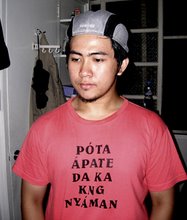
Alben meng manyaman, boy!

May 22, 2009

Kamaru photographs Palawan music video lead actors

Kalalangan Kamaru is currently in Palawan and will be back the 27th!

MODELS: JR Payuyo, Febbie Sabbaluca
LOCATION: Balsahan, Puerto Princesa City, Palawan

PHOTOGRAPHER: Diego Marx Dobles
POST-PROCESSING: Jason Paul Laxamana
LOCATION MANAGER: Jocelyn Fabello

Models will be the lead actors in the upcoming music video of "PLONING, ADIN KA REN" (Ploning, Where Are You) by Bulyaw Mariguen, a Cuyonon rock band. To be directed by yours truly.


May 19, 2009

Another [controversial] Filipino film at the Cannes Film Festival!

Brillante Mendoza: the “Love Him or Hate Him” Director
'Kinatay' stirs Cannes Film Festival

By Jason Paul Laxamana
Urban Kamaru
Central Luzon Daily


AFTER participating in the prestigious Cannes Film Festival last year with 'Serbis' -- a neorealist film about the Family Theater in Angeles City, San Fernando-born Brillante Ma. Mendoza is again vying for the main award, the Palm d'Or, in this year's festival with a violent film about the infamous “chop chop lady,” a grim character propagated by the news media in the late 90s. 'Kinatay' is also a co-production between Mendoza's Center Stage Productions and France' Swift Productions, the followup co-production after 'Serbis.'

The title of his latest work is 'Kinatay,' with English title 'The Execution of P.' Again written by Armando “Bing” Lao, 'Kinatay' is a story of a newly-married young police trainee who is need of more money to sustain his and his wife's education. To solve his problem, he goes with police officers to a clandestine mission of torturing a drug-addicted prostitute in Manila. Later on, the prostitute is mercilessly beaten, slaughtered, and chopped into bits, the parts wrapped in plastic, and thrown in various parts of Manila.

The movie, like in most Mendoza films, again stars Coco Martin. Mercedes Cabral, who played as the girl impregnated by Coco's character in 'Serbis,' is also back, along with Julio Diaz (also from 'Serbis'), and Lauren Novero (from 'Kaleldo'). The movie also stars Jhong Hilario, Maria Isabel Lopez, and John Regala.

Controversial again

As with last year's Philippine entry to the Cannes, 'Kinatay' has not failed to divide the audience and the film critics. There are those that brand the film as the worst entry in the festival, while others praise it for its unconventional style—no sensationalized scenes, slow rhythm, hand-held camera shots, absence of plot, lack of character development, and minimal lines. This is also partially thanks to the screenwriter, who is known to advocate for real-time scriptwriting.

This recurring style in Mendoza's films is what gets on the nerves of film critics who are not fans of the internationally acclaimed director. They describe 'Kinatay' as something that causes the audience alienation, resentment, and a feeling of having wasted money to see the film. Like in 'Serbis,' these critics also complain about the terrible traffic background sound which they describe as too noisy. Mendoza and Angeles City-residing producer Ferdie Lapuz both defend however that they are only trying to show the reality of noise pollution in the urban Philippines, which I couldn't agree more with.

The boldness of 'Kinatay,' on the other hand, makes it a probable choice in emerging victorious in the festival. Match, a German film distribution company, has picked up the controversial Filipino artwork for international distribution.


No more box office

Mendoza already knows that the films he loves to make aren't the films Filipinos want to see in theaters. That is why he just plans to hop from school to school to screen his films like 'Kinatay' to students, and then talk about the issue featured after the film. Such style of screening makes movie-watching more interactive, and makes education much more exciting than just being stuck in the classroom.

May 17, 2009

I AM ALWAYS A CONTEST LOSER, WAAAH! But...

For the past months, I have participated in a lot of contests both in the literary field and in the filmmaking field. Sadly, I have failed to become finalist in all of them, except one.

This is the great risk of writing and filmmaking -- you invest so much time, creativity, and even money (because you ship stuff to Manila, you buy DVD-Rs, print scripts and application forms, etc.) only to fail to become a finalist in the end.

Here are the contests I joined in:

Cinemalaya 2009 Short Film Category. My Asst. Director and I submitted two entries, Ing Bangkeru and Balangingi. We were torn between believing we can make it and conceding to the other filmmakers who have the money to produce technically good short films. But then in the end, we failed to penetrate the top 10.


Cinema One Originals 2009 Scriptwriting Contest. Unlike in the Cinemalaya Full-Length Category, where you have to submit only a synopsis of your film, in Cinema One, you have to submit a full-blown script -- which is what I did! I wrote a dramatic 80-page script about a male newbie in the Philippine literary scene and how the US financial crisis is indirectly affecting him. The title is Tagak at Tau (Egrets and People).

After my submission, I reviewed the finalists of the past year (finalists are given P1M to produce their scripts into films) and discovered that Cinema One is looking for out-of-the-box scripts, unlike Cinemalaya where their focus is realism and humanism. Cinema One welcomes experimental, science fiction, fantasy, and even horror. These are the genres I so love doing! Alas, I discovered that fact too late. And so, I lost again.

Carlos Palanca Memorial Awards for Literature. Alright, let me get this straight. I didn't join this year because I already conceded right even before I could start writing my entry to the short story category. I have joined for the past two years already -- first in the full-length Filipino stage play category, second in the English essay category -- and I lost, lost, lost! This year, I tried reading the entries of past winners, because the new Palanca website has made them available. The reading experience brings back memories of high school where you are required to read literary works which you barely understand, full of vocabulary words. I had no idea how my "dumbed down" works could fit in their roster. I decided not to join.

1st Philippine Digital Awards. This contest is very memorable to me because it's the first time I won an actual award/trophy. My entry was my Balangingi short film, which was classified under the ETC Short Film contest. The awarding was held at the World Trade Center in Manila, and it was the first time I delivered an acceptance speech on stage in front of the audience, composed of people I don't know and famous people like Gary V.


Ateneo Video Open 10. We joined in three categories: Short Narrative, Documentary, and Music Video. For short narrative, we submitted Ing Bangkeru and Balangingi. None of them made it to the top 5. For documentary, we submitted Sexmoan Adventures. It made it to the top 5! But when all the documentaries where screened at ADMU, Diego and I already conceded to Ang Pasko Ni Intoy. For music video, we submitted the music video of Oras by Mernuts and Alang Anggang Sugat by 5 Against The Wall. We can't figure out why none of those two became finalist, because honestly, the chosen finalists were blah. But hey, that's life. We got nothing in the end. At least our documentary was the funniest during the screening.

Most Outstanding Kapampangan Awards 2008. Lost in the Youth Category to a doctor who sortof like trained young people or something. Lost in the Culture and the Arts Category to a visual artist. Had I been entered in the Mass Media category, I would have also lost to internationally acclaimed filmmaker Brillante Mendoza. Oh well, another case for a 21-year old trying to compete in the contest of adults -- even in the Youth category.

Here are some more contests I joined, the results of which are still to be determined:

1st Flash Fiction Script Writing Contest by ACPI. ACPI stands for Animation Council of the Philippines, Inc. Yes! They (along with UNESCO) launched this contest that sought for scripts good for a 5-minute animation! Being a fan of anime and cartoons, I told myself I should join no matter what. I have been dreaming for the past few days of having a break in the young Pinoy animation (original content) industry by joining this contest and hoping to win! Not as an animator though; as a writer, because that's what the Pinoy animation industry needs.

I kinda like to think I have an advantage here. You see, scriptwriting for animation is a whole new discipline. It's not just any script. It's a very visual script. Try researching on it and you will understand. Are the literary giants to be feared here? Only if they are into animation and animation scriptwriting. Because no matter how good they are in writing, if they can't transform their works into an animations cript, it won't suffice. On the other side, we have the animators, or the animation students. They have long been exposed to this kind of skill, but the question now is--are they also good in creative writing?

Forgive me for sounding mayabang. I'd just like to think happy thoughts to save me from insanity in case I, again, lose in this contest. Anyway, I submitted Ang Mga Tagapangalaga Ng Bundok Arayat. I have often dreamed of making a comic book out of them, but since I can't draw much except for a couple of poses, I brushed off the idea. But I revived them for this contest.


The Farthest Shore: Fantasy From The Philippines. This is a literary contest seeking for Philippine secondary world-short stories (in English). What's a secondary world? Think Middle Earth of LOTR. Or the world in the Nick toon Avatar. Or the Mario World. Or, heck, even the Ibong Adarna world. In short, they were looking for stories written by Filipinos set in worlds that do not really exist, worlds only created by the writers. I wrote mine while I was having a vacation in the US. Title is The Destiny Twines of Makaru, set in a continent called Quemardican, in the country of Kasulipan. Fusion of local Kapampangan folklore and advanced psychic technology.

On the other hand, even though I often lose in contests, there is this thing I find weird. I may always be a contest loser, but how come I often get invited to screen my works? For instance, just last Friday, I was invited to deliver a talk on indie filmmaking at the Red Horze Muziklaban Rock Challenge, which now also embraces Indie Filmmaking, Tattooing, and Extreme Sports.

I had my own Indie Film booth at the kickoff party where I was able to screen all of my works to those interested to see. Shorts, docus, music videos, PSAs, and even the first episode of Kalam, I all screened! And then, when it was time for me to give a lecture, I also had two music videos shown (Alang Anggang Sugat and Kaplas) on the big screen on stage.

I'd like to think people were "amazed." After the event, I was even approached by this adult man named Bobby who so loved my work, he said he won't leave the party unless I give him a copy of my works.

Speaking of film, I also became the sole Pampanga participant in the Cinema Rehiyon Film Festival last February. Ing Bangkeru was screened at the CCP Dream Theater to represent Kapampangan indie cinema.

The music video of Oras by Mernuts which I directed has been accepted in the Tong Hits segment of MTV Pilipinas, making it the first ever Kapampangan music video to penetrate MTV. Two of my projects have been featured in Kapuso Mo, Jessica Soho separately. First was RocKapampangan, in their feature on the regional-language rock scene in the provinces. Second was Kalam, in their feature on regional-language TV dramas and films.

Ing Bangkeru has also served as front-act film to Brillante Mendoza's internationall acclaimed films (Manoro, Kaleldo, and Foster Child) when they were screened at the Holy Angel Auditorium. Around two thousand pairs of eyes were watching, and it sent shivers down my spine when they applauded after watching Ing Bangkeru (after watching the arrogant student get mentally owned by the lowly boatman).

In the field of literature, I was also chosen by UP Pampanga to represent Kapampangan literary writing (Junior Category) in the 1st Taboan Philippine International Writers Festival held at Quezon City.


In the field of cultural work, I have been invited to speak in various lectures. Language-related. Film-related. Culture-related. In both Pampanga and Quezon City. I've often been interviewed for the theses of different people. Even postgrad theses.

This is what I find weird.

I often lose in contests.

But I often get invited in these non-competition stuff.

I should be proud, I know, but I don't know... Maybe I yearn to win in a competition because it will give me a sense of hard-earned victory, defeating all others who joined... which is more valuable than just being "chosen".

Oh well, Regine Velasquez will always be my constant reminder. How she lost in more than 50 contests, and now, look at her! She's lovers with Ogie! And, oh yeah, she's a Songbird.

May 11, 2009

Nievera's 'Lupang Hinirang' - another exaggerated issue, proof of Pinoy shallowness

Conrado De Quiros wrote pretty well about the Martin Nievera issue. The brouhaha about the so-called "desecration" of the national anthem by proud nationalists is proof how insecure Filipinos are regarding their patriotism. They are superficial.

Theres The Rub
Footnote to a false note

By Conrado de Quiros
Philippine Daily Inquirer
First Posted 02:22:00 05/11/2009

I beg to disagree with some friends on this. “This” is the way Martin Nievera sang “Lupang Hinirang” in the Pacquiao-Hatton fight, which has brought him into a brawl with preservers of Filipino tradition.

The fight has so far been lopsided, with many authority figures, from congressmen to historians, knocking him down with a chorus of irate voices.

I myself have no problems with it. In fact I have a couple of reasons for liking it.

The first has to do with the barb that Nievera went the route of show biz by aping the American singers (mostly black) who make the “Star-Spangled Banner” sound like Motown each time an American boxer takes to the ring. Which, as the nastier remarks go, is probably because Nievera is an American at heart and on paper. I leave others to argue where Nievera’s loyalties lie, though given all the open and closet “statehooders” here—Filipinos who long for the country to become a state of the United States—not least among the congressmen, I wouldn’t advise pressing this point too loudly.

But even if Nievera went show biz, what of it? Boxing is pretty much show biz, of the loud and glittery type. And though Nievera did not sing “Lupang Hinirang” traditionally, he did not disrespect it either, to use a word much favored by African-Americans.

The reason Americans do not mind their National Anthem sung like gospel (or its modern reincarnations; I wouldn’t be surprised if it becomes hip-hop one day) is that they are secure in their patriotism. They are secure in their sense of country. They are secure in their loyalty to flag and country. Enough to withstand Jimi Hendrix’s “sacrilegious” interpretation of the “Star-Spangled Banner,” which he did in Woodstock, his awesome guitar blaring out the din of discord in protest against the Vietnam War. That version has since been elevated to iconic status by baby boomers.

Our prissiness with orthodoxy is in fact a symptom of an affliction as worrisome as swine flu. We like revering tradition because we prefer form over content, because we like showing our love of country in ritual rather than in practice. We like to build busts and monuments to the heroes without liking to follow their ideals and actions, which is really the best tribute to them. The religious equivalent of this is that we like to hear Mass and receive the sacraments without liking to live lives that are not given to lying, cheating, stealing and murdering.

It’s like that line in “Lupang Hinirang:” “Ang mamatay nang dahil say iyo” (“to die for you”). I’ve always said that was a perfect, if ironic, commentary on us. We’ve never had problems dying for country, we’ve always had problems living for it. I’ve always suggested—utter sacrilege!—changing it to, “Ang mabuhay ng dahil sa iyo” (“to live for you”).

My second point is: Why on earth should we regard tradition as intractable or unchangeable?

Even the Rock, or the Church, changes. I still remember the time when the Mass, which used to unfold with Latin incantations, gave way to idiomatic English. Or indeed, horror of horrors, when the Gregorian chant gave way to the “Guitar Mass.” Once things that threatened to make the faithful faithless, plain language and (middle-of-the- road) pop (if not rock) are rock-solid orthodoxy in Masses now.

In the case of historical tradition, I should think changes should not just be acceptable to us, they should be welcome to us. I say this because our lack of sense of history—truly notorious in that we can’t even remember the recent past—owes in great part to our tendency to embalm history. To treat it as something dead and gone and remembered only on the historical equivalents of All Saints’ Day. One natural consequence of this is to turn history into sacred text and the heroes into untouchable objects of worship.

I still remember how we used to look at Jose Rizal, Andres Bonifacio, Apolinario Mabini and the other heroes that way, courtesy of high school and college. Something the new wave of historians led by Renato Constantino corrected, turning them into ordinary folk who did extraordinary things in their time and place. No less, or more, than the activists did in their time and place. The process of demystification, or “humanization,” would culminate in historians like Ambeth Ocampo who would make Rizal et al. as contemporary as, well, Nievera’s rendition of the National Anthem.

Which makes me wonder why Ambeth in particular should disapprove of that rendition. I recall that when he was pilloried by purists for “watering down” history with his “pop” version of it, I wrote a column saying that far from detracting from the worth of history, he added to it. Specifically by making the past present, by making the dead living, by making history not history in the idiomatic sense of “we’re outta here” but history in the sense of current events. The power of history lies precisely in its being living history, or a “continuing past,” as Constantino put it. One would imagine that a continuing past uses the idioms or idiosyncrasies of the flowing present. That’s what makes the past worth remembering. That’s what makes the past worth living.

It’s not just that I don’t think Nievera has done any harm by his version, it is that I think he has done much good with it. Anything that hooks the youth in particular of this amnesiac country to their past, even if it feels like a right hook to those who take that past reverentially, is fine by me. History has been known to rock, history has been known to roll. Sometimes, history has even been known to OPM.

In any case, I have a lot of friends who’ve always thought the National Anthem wasn’t “Lupang Hinirang” but Juan de la Cruz’s “Ang Himig Natin.”

May 10, 2009

New Kapampangan rock music video - Happy Mother's Day!

Happy Mothers' Day (Masayang Kayaldawan da ring Ima) to all of our dear mothers! Before I left for the US, we were able to shoot the band scenes of Mental Floss' music video for their RocKapampangan song "Ing Lugud Ning Indu" (Love of a Mother). We really intended to finish the video by Mothers' Day, but sadly, we didn't.

So I'll just say: Abangan! Here are some screen captures from the video. If you notice, the vocalist is pregnant, too! She's soon to become a mother! Congrats, Nicole!


Meanwhile, here is an old video of Mental Floss performing 'Ing Lugud Ning Indu.' Don't you think it's a nice Kapampangan song?